 globalgrillguidecom
Table of Contents
Why Airflow Is the Hidden Engine of Every Grill
Most people think great barbecue comes down to meat quality, a good rub, or some secret sauce recipe handed down through generations. Those things matter, sure. But behind every perfectly smoked brisket and every juicy rack of ribs is a quieter hero – airflow.
Fire is simple in theory. It needs heat, fuel, and oxygen. Remove one of those and the fire dies. Control them carefully and you get stable cooking heat that turns tough meat into tender barbecue magic.
This is where airflow control in grills becomes the hidden engine of the entire cooking process. When oxygen flows into a grill, the fire burns hotter. When oxygen is restricted, the fire calms down and temperatures drop.
Understanding that simple relationship is the foundation of grill temperature control. Without airflow management, you’re basically cooking with a chaotic campfire that does whatever it wants.
And if you’ve ever wondered why my grill temperature keeps changing, airflow is almost always the answer.
Once you learn how to manage it, your grill stops feeling like a stubborn machine and starts behaving like a precision cooking tool.
The Physics of Grill Temperature
Let’s talk about the science for a moment – but don’t worry, this isn’t a physics lecture. Think of it more like BBQ common sense. Every grill works on convection. Hot air rises, cool air enters, and the cycle continues as long as the fire burns. When fresh oxygen enters through vents, combustion intensifies and heat output increases. That’s why how airflow affects grill temperature is one of the most important concepts any griller can understand.
More oxygen means:
• faster combustion
• hotter fire
• higher grill temperature
Less oxygen means:
• slower combustion
• cooler fire
• lower grill temperature
In practical terms, this is how managing heat in a grill actually works.
Your vents act like the throttle pedal on a car. Push it down and the engine revs higher. Ease off and things slow down.
Understanding this relationship is the foundation of professional-level grill temperature management.
How Airflow Controls Heat Inside a Grill
Inside every grill there are two airflow systems working together. The intake vents bring fresh oxygen into the firebox. The exhaust vents release hot air and smoke. This balance is what pitmasters call intake vs exhaust vents BBQ control.
When the intake vent opens wider, more oxygen enters the fire and the flames grow stronger. When the exhaust vent opens wider, hot air exits faster, pulling fresh air through the grill like a chimney.
Together, these create the airflow loop that determines heat stability.
In charcoal smokers, charcoal grill airflow vents are the primary way to control temperature. Gas grills rely on burners for heat, but airflow still affects how evenly that heat circulates.
In smokers, the concept goes even deeper because you’re actively controlling oxygen in a smoker to maintain long low-temperature cooking sessions.
Understanding how vents affect grill temperature is the first step toward mastering consistent BBQ results.
The Biggest Temperature Mistakes Grillers Make
Even experienced grillers make a few classic airflow mistakes.
The first is constantly opening the lid. Every time the lid opens, heat escapes and airflow patterns change. It’s like trying to bake a cake while repeatedly opening the oven door.
The second mistake is over-adjusting vents. People panic when temperatures drift by ten degrees and start moving vents every few minutes.
That leads to unstable fire behavior and makes maintaining consistent grill temperature nearly impossible.
Another common issue happens when grillers dump in too much fuel. More charcoal does not automatically mean more control. It usually means a hotter fire that becomes difficult to tame.
The secret to how to keep grill temperature steady is patience. Small adjustments, followed by waiting ten to fifteen minutes, will always beat constant tinkering.
Good barbecue rewards calm cooks.
Why Your Grill Lid Thermometer Is Probably Lying
Many grills come with a built-in thermometer in the lid. It looks official. It feels trustworthy. Unfortunately, it’s often wildly inaccurate.
Most lid thermometers measure air temperature near the top of the grill, which can be 50–100°F hotter than the cooking grate where your food actually sits.
This is why grill vent settings explained in many guides can feel confusing. You might think your grill is running at 225°F while your brisket is actually sitting in 275°F heat.
That difference can completely change cooking time and moisture retention.
Serious pitmasters rarely rely on lid thermometers alone. Instead, they measure temperature directly at the cooking surface.
Ambient Temperature Monitoring – Grate-Level Truth
If you want accurate temperature readings, you need a probe positioned near the food.
This method measures the true ambient cooking environment and removes the guesswork from grill temperature control tips.
Ambient probes track the air temperature around the meat, allowing you to monitor real heat conditions.
That is essential for smoker temperature control techniques and long cooking sessions.
When you monitor grate-level heat instead of lid temperature, your cooking decisions become far more precise.
And precision is what separates good barbecue from unforgettable barbecue.
How to Stabilize Temperature with Digital Probe Thermometers
Modern digital thermometers changed the BBQ world. Instead of guessing temperatures, grillers now rely on probes that monitor both meat and ambient heat simultaneously. These tools are the backbone of reliable grill temperature control.
A probe clipped to the grate monitors the cooking environment, while another probe inserted into the meat tracks internal doneness.
This dual monitoring approach helps you avoid overcooking and ensures how to control grill temperature becomes a predictable process instead of a guessing game.
Why Probe Thermometers Are the Foundation of Temperature Control
A probe thermometer acts like a dashboard for your grill. Without one, you’re basically driving a car without a speedometer.
These tools provide the feedback needed to manage airflow and heat control BBQ strategies effectively.
When temperatures begin drifting, you know immediately whether to adjust vents, fuel, or airflow.
This is why experienced pitmasters consider digital thermometers essential equipment rather than optional accessories.
Multi-Probe Monitoring Explained
Multi-probe thermometers allow you to monitor several things at once. One probe measures the brisket. Another tracks the pork shoulder. A third measures the cooking environment. This system provides a full picture of what’s happening inside your grill.
For long cooks, especially in smokers, this setup is critical for maintaining consistent grill temperature.
Wireless vs Bluetooth Thermometers
Wireless thermometers use radio frequency to send signals to a handheld receiver. Bluetooth models connect to smartphone apps, allowing you to monitor temperature from your couch or kitchen.
Both systems help answer one of the most common grilling frustrations – why my grill temperature keeps changing.
Wireless systems often provide longer range, while Bluetooth models offer detailed mobile apps and alerts. Either option makes temperature monitoring far easier than the old “open the lid and guess” method.
Best Digital Probe Thermometers for Temperature Control
A few thermometers have become favorites among serious grillers because they combine reliability, accuracy, and ease of use.
Below are three standout options.
ThermoPro TP20 Wireless Thermometer
The ThermoPro TP20 is one of the most popular wireless BBQ thermometers for a reason.
It offers dual probes, a strong wireless signal, and pre-programmed temperature settings for different meats.
The wireless receiver allows you to monitor your cook from up to 300 feet away, which is perfect when you’re entertaining guests or preparing side dishes.
You can check current pricing here: ThermoPro TP20
The TP20 helps grillers maintain grill temperature management without constantly hovering over the grill.
INKBIRD IBT-4XS Bluetooth Thermometer
The INKBIRD IBT-4XS is a powerful Bluetooth thermometer that supports four probes simultaneously.
Its smartphone app tracks temperatures in real time and records cooking history.
This makes it especially useful for experimenting with smoker airflow control and documenting results for future cooks.
It also features a rechargeable battery, which many users prefer over disposable batteries.
Check current availability here: INKBIRD IBT-4XS Bluetooth Thermometer
MEATER Plus Smart Wireless Thermometer
The MEATER Plus is one of the most innovative thermometers available.
Instead of wires, it uses a completely wireless probe that measures both meat temperature and ambient heat inside the grill.
This dual measurement is incredibly helpful when learning how to control heat on charcoal grill setups.
Its mobile app provides guided cooking instructions and predictive finish times.
See current pricing here: MEATER Plus Smart Wireless Thermometer
Understanding the Difference Between Meat Temperature and Grill Temperature
Many beginners assume grill temperature and meat temperature are the same thing. They are not. Grill temperature describes the heat surrounding the meat. Meat temperature describes how cooked the food actually is.
Understanding the difference is essential for mastering grill temperature control.
A brisket cooked at 225°F might take 12 hours to reach the desired internal temperature, while one cooked at 275°F might finish several hours earlier. Monitoring both values simultaneously is the key to consistent barbecue results.
Grate Thermometers – Measuring Real Cooking Heat
Grate thermometers measure the temperature exactly where your food sits. They provide a direct view of the cooking environment and are often more accurate than lid thermometers.
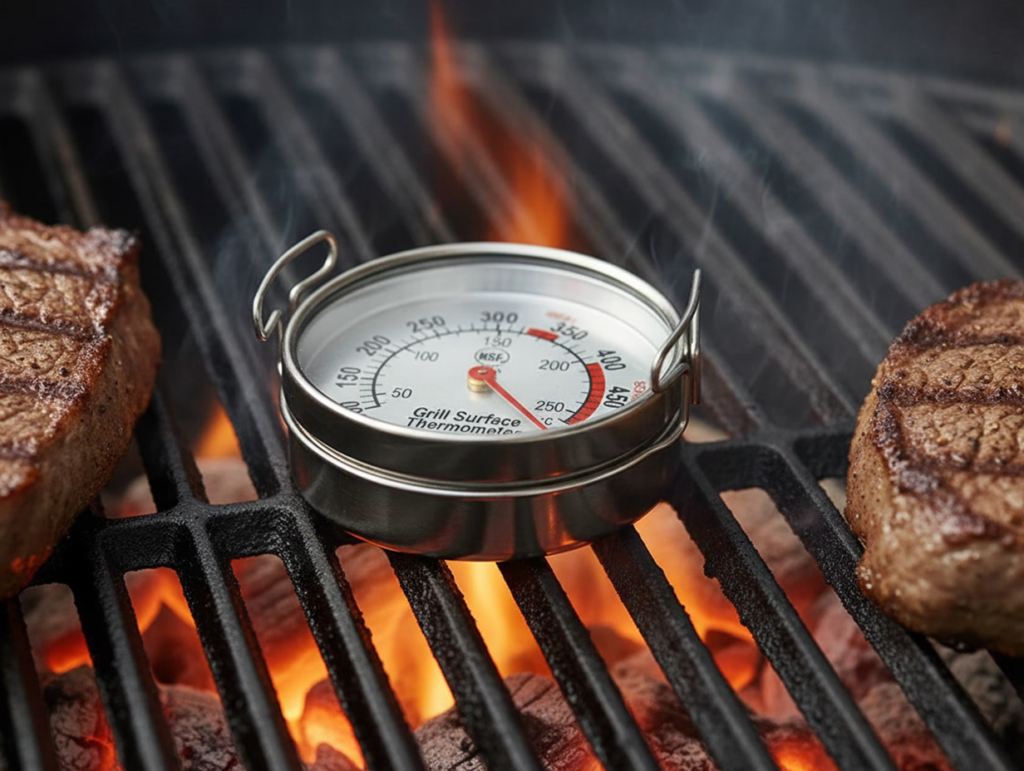
These tools are especially useful for grillers learning how airflow affects grill temperature.
Taylor Precision 5932
The Taylor Precision 5932 is a simple and reliable grate thermometer. Its large dial is easy to read and it handles high heat without problems.
You can check availability here: Taylor Precision 5932
For grillers who prefer straightforward tools without digital features, this thermometer offers dependable performance.
Cuisinart CSG-100 Surface Thermometer
The Cuisinart CSG-100 sits directly on the cooking grate and measures surface heat. This helps identify hot spots and understand how to increase grill heat with vents in specific areas of the grill.
See the current price here: Cuisinart CSG-100
Rubbermaid Commercial FTGRO550
The Rubbermaid Commercial FTGRO550 is designed for commercial kitchens but works perfectly for grill monitoring. Its stainless steel construction and accurate readings make it a durable choice for serious grillers.
Check it here: Rubbermaid Commercial FTGRO550
Escali AHG2 Surface Thermometer
The Escali AHG2 is another excellent grate-level thermometer with a large display and fast readings. It’s a great option for monitoring heat when practicing BBQ airflow tips for beginners.
View current pricing here: Escali AHG2 Surface Thermometer
Two-Zone Cooking and Airflow Management
Two-zone cooking divides your grill into a hot side and a cooler side. This setup allows you to sear food over high heat and then move it to indirect heat for gentle cooking. Airflow management becomes much easier when using two zones because fuel concentration naturally creates temperature differences.
This technique is one of the most effective strategies for managing heat in a grill.
How to Stabilize Temperature in Charcoal Grills
Charcoal grills rely heavily on vent control. To stabilize heat, start by adjusting the intake vent slightly open and leaving the exhaust vent mostly open. Then add charcoal gradually rather than dumping large amounts at once. These small changes help control combustion and improve how to control grill temperature during long cooks. Patience is key when learning how to lower grill temperature. Close vents slightly and give the fire time to respond.
How to Stabilize Temperature in Gas Grills
Gas grills offer easier temperature adjustments because burner output can be changed instantly. However, airflow still matters. Wind, lid openings, and uneven burner use can disrupt heat distribution. Monitoring temperature with probes and adjusting burners gradually helps maintain stable cooking conditions. This is one of the simplest methods for maintaining consistent grill temperature.
Advanced Airflow Control – Automatic Draft Controllers
Technology has pushed grill temperature control into the world of automation. Automatic draft controllers regulate airflow using small fans connected to temperature sensors. When the grill temperature drops, the fan increases airflow to boost combustion. When temperatures climb too high, the fan slows down. This system keeps the fire stable without constant manual adjustments.
Why Serious Pitmasters Automate Airflow
Long overnight cooks are exhausting when you have to check the grill every hour. Automatic controllers allow pitmasters to sleep while the system maintains stable temperatures. They are especially useful for smokers where controlling oxygen in a smoker is critical. Automation turns unpredictable charcoal fires into stable heat sources.
Inkbird ISC-027BW Smart Temperature Controller
The Inkbird ISC-027BW is one of the most accessible automatic draft controllers available. It connects to a temperature probe and regulates airflow using a small fan attached to the smoker intake vent. The result is incredibly stable temperature control during long cooks.
Check current pricing here: Inkbird ISC-027BW
For anyone serious about grill temperature control, tools like this can completely transform the cooking experience.
Creating a Complete Temperature Monitoring System
A strong BBQ monitoring system usually includes three components:
• a meat probe thermometer
• an ambient grill probe
• a grate-level thermometer
Together they provide a complete picture of your cooking environment. This setup eliminates guesswork and dramatically improves grill temperature control.
Airflow Troubleshooting Guide
If temperatures keep drifting, check the following issues.
- First, inspect vents for blockages. Ash buildup can restrict airflow and cause unstable heat.
- Second, confirm that vents are adjusted gradually rather than dramatically.
- Third, monitor wind conditions. Strong wind can dramatically alter airflow patterns and disrupt smoker airflow control.
- Finally, confirm your thermometers are calibrated correctly.
Most temperature problems come down to airflow imbalance or inaccurate readings.
Choosing the Right Thermometer Setup for Your Grill
Every grill setup benefits from a slightly different monitoring system.
Charcoal grills benefit most from ambient probes and grate thermometers.
Gas grills benefit from meat probes and burner adjustments.
Pellet grills already regulate airflow automatically, but external thermometers still provide valuable verification.
Choosing the right combination of tools ensures stable grill temperature control across different cooking styles.
FAQ
How does airflow affect grill temperature?
Airflow controls how much oxygen reaches the fire. More oxygen increases combustion and raises the grill temperature, while restricting airflow slows the burn and lowers the heat. Proper vent adjustment helps maintain a stable cooking temperature.
How do you control temperature on a charcoal grill?
Temperature on a charcoal grill is controlled mainly by adjusting the intake and exhaust vents. Opening the vents increases airflow and heat, while closing them reduces oxygen and lowers the temperature.
What grill vent settings should I use?
For higher heat, keep both intake and exhaust vents more open. For low-and-slow cooking, slightly restrict the intake vent while leaving the exhaust mostly open to allow smoke to escape.
Why does my grill temperature keep fluctuating?
Temperature swings usually happen because of inconsistent airflow, too much or too little fuel, or frequently opening the lid. Stabilizing vent settings and limiting lid openings helps maintain steady heat.
How do you keep grill temperature steady for long cooks?
Use consistent fuel placement, adjust vents gradually, and monitor temperature with a reliable thermometer. Maintaining proper airflow balance is the key to stable long BBQ sessions.
Final Thoughts – Mastering Airflow Means Mastering the Grill
Barbecue might look simple from the outside. You light a fire, cook some meat, and enjoy the results. But beneath that simplicity lies a fascinating balance of airflow, combustion, and temperature control.
Understanding how airflow affects grill temperature changes the way you approach grilling forever.
Once you learn how to manage vents, monitor temperatures, and stabilize airflow, your grill stops being unpredictable. It becomes a precision cooking machine capable of producing consistently incredible barbecue. And when that happens, something magical occurs. Friends start asking how your ribs are always perfect. Neighbors wander over when they smell the smoke. And suddenly you’re the person everyone calls when it’s time to fire up the grill.
Which, let’s be honest, is exactly the reputation every griller secretly wants.