
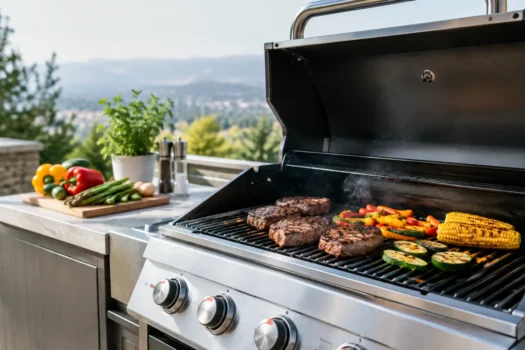
A 60,000-BTU gas grill can be a strong backyard cooker. It can also be a large, thin-metal grill that burns through fuel, struggles in wind, and still fails to brown a steak properly. That is the problem with shopping by gas grill BTUs alone: the number sounds definitive, while the real cooking result depends on much more.
BTU ratings are useful, but only when you understand what they measure and what they leave out. A better grill purchase comes from looking at burner output alongside cooking area, construction, heat distribution, grate design, and the way you actually plan to cook.
What Gas Grill BTUs Actually Measure
BTU stands for British Thermal Unit. In grill specifications, it generally describes how much heat a burner can produce in one hour at its maximum setting. A grill with three 12,000-BTU main burners is rated for 36,000 BTUs across the primary cooking area.
That number is a measure of fuel-burning potential, not a promise that the grill grate will reach a certain temperature. It also does not tell you how evenly heat will spread from front to back, how much heat will escape through the lid and firebox, or whether the grill can hold a steady low temperature for chicken or ribs.
Manufacturers know that a larger number catches attention. That is why total BTUs often get prominent placement on product pages, while more meaningful details – such as the thickness of the firebox, the size of the actual cooking surface, or the material under the grates – can be harder to find.
Main burner BTUs are the number that matters
When comparing grills, start with the BTUs assigned to the main cooking burners. Do not let a side burner, rotisserie burner, or sear burner inflate the total in your head.
A side burner may be handy for heating a sauce, but it contributes nothing to the grill’s ability to cook burgers evenly. A dedicated infrared sear burner can be genuinely useful, but it should be evaluated as a separate feature. Its output does not make the regular grill burners more capable.
If a listing says a grill has 70,000 total BTUs, find out how those BTUs are allocated. A 45,000-BTU main grill with a 15,000-BTU side burner and a 10,000-BTU rotisserie burner is not the same as a 70,000-BTU primary cooking system.
Gas Grill BTUs Per Square Inch Are More Useful
The more practical comparison is heat output relative to primary cooking area. Divide the main burner BTU rating by the square inches of primary grate space. This gives you a rough BTU-per-square-inch figure.
For example, a 36,000-BTU grill with 500 square inches of primary cooking space works out to 72 BTUs per square inch. A 48,000-BTU grill with 800 square inches works out to 60. The first grill has less total burner output but more available heat for each square inch of food space.
As a broad shopping reference, many capable gas grills land somewhere around 70 to 100 BTUs per square inch on the primary cooking area. That range is not a pass-fail rule. A well-built grill can cook well below it, while a poorly designed high-output grill can still be disappointing. It is simply a better starting point than total BTUs.
A very low number may mean slow preheating and limited high-heat performance, especially on a large grill. An unusually high number can mean fast preheating, but it can also mean more fuel consumption and less forgiving control at lower settings. Neither extreme automatically makes a grill right for your backyard.
Why Higher BTUs Do Not Always Mean Better Grilling
Heat that never reaches the cooking grate is wasted fuel. This is where build quality separates a satisfying long-term grill from a spec-sheet bargain.
A heavier lid and firebox retain more heat. Well-designed heat diffusers protect burners while spreading heat across the grate. Solid grates absorb and transfer heat into food more effectively than lightweight wire grates. Tight lid fit, sensible venting, and burner placement all affect whether the grill cooks consistently.
Consider two similarly sized grills. One has high-output burners but a shallow firebox, thin stainless components, and widely spaced grates. The other has moderate output, a deeper firebox, heavy porcelain-coated cast-iron grates, and properly fitted flame tamers. The second grill may preheat just as well, recover temperature faster after the lid opens, and produce better browning with fewer hot spots.
That is why a grill’s maximum lid thermometer reading is not enough, either. A grill can show 600 degrees near the top of the lid while leaving cool areas at the grate. What matters is usable grate heat across the surface where dinner actually cooks.
Searing is not just a BTU question
Good searing requires concentrated heat at the grate and grates with enough mass to transfer that heat into the food. High burner output helps, particularly for thin steaks, burgers, and fast-cooking vegetables. But it is only part of the equation.
Standard tube burners with quality heat tents can create excellent searing zones. Dedicated infrared burners can create more intense, localized heat, which is useful if you regularly cook steaks or chops. The trade-off is that infrared burners can be less flexible for delicate foods and may require more attention to avoid scorching.
Do not buy a larger grill solely because it advertises a bigger BTU number if you usually cook for two to four people. A smaller, well-built grill with a strong hot zone is often easier to control and more economical to run.
Match Burner Output to How You Cook
Your cooking habits should decide how much output and cooking area you need. For weeknight burgers, chicken thighs, vegetables, and occasional steaks, a mid-sized two- or three-burner grill with balanced burner output is usually enough. You need reliable ignition, even heat, and enough room to set up a direct and indirect zone.
If you often cook for a crowd, capacity becomes more important. Look for enough primary grate space to avoid cramming food together, then make sure the main burners provide adequate output for that larger area. Crowding is a common reason backyard cooks blame a grill for weak browning when the real issue is too much cold food on too little hot grate.
If low-and-slow cooking is part of the plan, do not assume more BTUs are better. You need burners that can turn down predictably, a lid that holds heat, and enough burner control to create an indirect zone. A grill that races from low to hot with little adjustment range can make chicken, fish, and ribs frustrating.
Cold climates and windy patios also change the equation. A grill that performs acceptably on a calm summer day may lose heat quickly in colder weather. Better construction and wind protection matter more than chasing an inflated BTU rating. Never block a grill’s required ventilation, but placing it in a safe, sheltered location can improve consistency.
What to Check Beyond the BTU Rating
Before buying, look past the headline number and inspect the parts that determine daily performance. Check the primary cooking area, then calculate the approximate BTUs per square inch using only the main burners. Look for independently controlled burners, because multiple zones make indirect cooking and temperature management far easier.
Pay attention to grate material. Cast iron holds heat well but needs regular cleaning and seasoning if it is not porcelain coated. Stainless steel is durable and lower maintenance, though thin rods do not store as much heat as heavier grates. Also check the firebox, lid, burners, flame tamers, grease system, and replacement-part availability. These are the components that affect ownership after the first few exciting cooks.
A quick preheat test tells you more than a BTU label when you can see a grill in person or read a detailed hands-on review. Does it heat across the whole grate? Are there obvious cool corners? Can it hold a moderate temperature without constant adjustment? Does grease drain cleanly, or does it collect around the burners? Those answers matter every time you cook.
The Practical Bottom Line
Use gas grill BTUs as a comparison tool, not a verdict. Compare main burner output to primary cooking area, then weigh that result against the grill’s materials, burner control, grate quality, and heat-management design.
The right grill is not the one with the biggest number on the box. It is the one that reaches cooking temperature without wasting fuel, gives you a useful range from gentle heat to a hard sear, cleans up without drama, and still performs after several seasons outdoors. Buy for that reality, not for a number designed to win a showroom glance.