 globalgrillguidecom
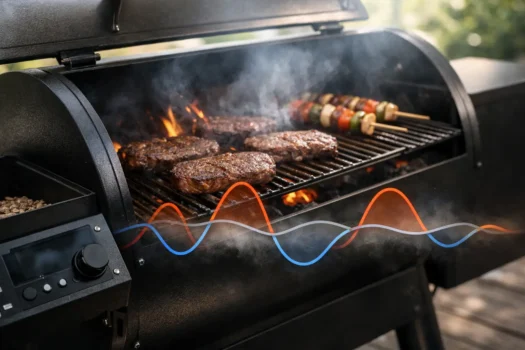
You set your pellet grill to 250, glance back ten minutes later, and the display says 215. A few minutes after that, it jumps to 278. That is usually the moment people start wondering whether they bought a bad grill. In many cases, pellet grill temperature swings are normal. The real question is how much swing is acceptable, what causes it, and when it points to a setup or hardware problem.
Why pellet grill temperature swings happen
A pellet grill is not an indoor oven. It is managing live fire, moving air, fuel feed, and a temperature probe that reacts to changing conditions in real time. Even very good pellet grills cycle above and below the set point because the controller is adding pellets, igniting them, and then waiting for the chamber to respond.
That cycle matters. When pellets drop into the fire pot, the grill gets a fresh burst of fuel. Heat rises. Then the controller pauses pellet delivery, the fire settles, and the temperature drops before the next feed. Some controllers smooth this out better than others, but none hold a dead-flat line the way marketing photos suggest.
Weather adds another variable. Wind can pull heat out of a cooker fast, especially if the body is thin or the lid seal is loose. Cold ambient temperatures force the grill to work harder. Direct sun can do the opposite and make readings look steadier or hotter than expected. None of that means the grill is defective. It means you are cooking outdoors.
What counts as normal swing and what does not
A small amount of variation is expected. On many pellet grills, swings of roughly 15 to 25 degrees in either direction during normal cooking are not unusual. Some run tighter than that, especially premium models with better controllers, thicker steel, and better airflow design. Others wander more.
Where people get tripped up is by watching the digital readout too closely. The number on the screen is not the same as the temperature at the grate where your food sits. It is simply what the grill’s sensor is seeing at that moment in its mounted location. If the display moves around but your ribs, pork shoulder, or chicken still cook on schedule and come out consistently, the grill may be operating fine.
The line between normal and problematic usually shows up when swings are large, repeated, and disruptive. If your grill is set to 250 and regularly crashes near 180 or spikes over 325 without lid openings or weather extremes, that is no longer typical behavior. If it struggles to recover, overshoots badly, or keeps snuffing the fire and restarting, you are dealing with more than harmless fluctuation.
The most common causes of pellet grill temperature swings
The controller gets blamed first, but it is not always the main issue. Pellet quality is one of the biggest reasons for inconsistent heat. Cheap pellets, damp pellets, or pellets with excessive dust do not burn as predictably as dry, dense pellets. That means uneven combustion, weaker fire, and erratic recovery.
A dirty grill is another common culprit. Ash buildup in the fire pot restricts airflow and changes how pellets ignite and burn. Grease and carbon buildup can also affect internal airflow patterns. Pellet grills are advertised as convenient, but they are not maintenance-free. If you ignore the fire pot and interior for too long, temperature control usually gets worse before it gets better.
Probe condition matters too. If the temperature sensor is coated with grease and soot, it may read slowly or inaccurately. That can make the controller overfeed or underfeed pellets because it is reacting to bad information. A quick cleaning often helps more than people expect.
Then there is pellet feed itself. Auger inconsistencies, bridging in the hopper, or partial jams can cause a starved fire followed by an overcorrection once fuel starts moving again. You may see this as long dips and then aggressive spikes. Some grills are also simply built with weaker controller logic, less refined fan control, or thinner construction that makes them more reactive to outside conditions.
Pellet grill temperature swings and where you measure heat
This is where a lot of confusion starts. The grill’s built-in sensor is usually mounted on a side wall inside the cooking chamber. Your food is on the grate, often several inches away, and not always in the same airflow path. Those are not identical environments.
If you place a reliable grate-level thermometer near your food, you may find that the cooking temperature is more stable than the display suggests. Or you may learn the opposite – that the grill’s display is calm while the grate has a hot side and a cool side. Both scenarios happen.
That is why one display number should never be treated as the whole story. For low-and-slow cooking, average temperature over time matters more than every short-term bounce. A cooker that cycles between 235 and 265 but averages close to target can still turn out excellent barbecue. A grill that appears stable but runs 35 degrees hotter at grate level can create bigger problems.
How to reduce temperature swings without chasing perfection
Start with the basics before assuming you need replacement parts. Use good pellets and store them somewhere dry. If pellets feel soft, crumble easily, or show obvious swelling, replace them. Fuel quality is too important to treat as an afterthought.
Next, clean the grill. Empty the fire pot, vacuum out loose ash, and wipe the temperature probe carefully. Check the grease path while you are in there. Better airflow and a clean sensor give the controller a fair chance to do its job.
Pay attention to startup habits. Let the grill complete its ignition cycle properly before making adjustments. Constantly changing the set temperature early in the cook can create more instability, not less. The same goes for opening the lid too often. Every lid opening dumps heat and forces the controller into recovery mode.
Placement helps more than many owners realize. If your grill sits in an exposed corner with steady crosswind, temperature swings will usually be worse. Moving it to a more sheltered spot can improve consistency immediately. In colder climates, an insulated blanket made for the grill can also help, though it depends on the model and season.
Some grills offer smoke mode or specific controller settings that naturally create wider swings. That is not always a flaw. More smoke often comes from a less stable, smoldering burn pattern. If your goal is tighter heat for baking, roasting, or cooking delicate items, a standard cook mode at a moderate temperature usually behaves better.
When swings point to a real problem
If you have ruled out pellets, weather, cleaning, and user habits, the remaining issue may be mechanical or electronic. A failing igniter can cause poor fire establishment and erratic recoveries. A weak combustion fan can reduce oxygen supply and create a lazy, unstable fire. An auger motor that feeds unevenly will also throw off temperature control.
Controllers can fail too, but they are not the only suspect. Before replacing one, look for signs that support the diagnosis. Repeated shutdowns, wild overshoots, fire pot overfilling, or temperature readings that make no sense even with a clean probe are better clues than a display number that moves around by 20 degrees.
Build quality also matters here. Thin metal bodies, poor lid fit, and loose seams do not just affect efficiency. They make the grill harder to control in the first place. That is one reason two pellet grills with similar advertised features can perform very differently over a long cook.
What this means if you are shopping for a pellet grill
If you are comparing models, do not judge temperature control by brochure claims alone. Most brands advertise precision. Real ownership tells a different story. Look for evidence of consistent cooking results, solid construction, good hopper and auger design, accessible cleaning, and a controller that recovers predictably rather than just chasing numbers.
This is also where realistic expectations matter. A pellet grill that holds within a narrow band most of the time, recovers cleanly after lid openings, and produces repeatable food is doing its job. You are buying an outdoor live-fire cooker, not a lab instrument.
At Global Grill Guide, this is exactly why we put more weight on real cooking behavior than polished feature lists. A grill that looks smart on paper but swings wildly, struggles in wind, or becomes finicky after a few cooks is not a good long-term value.
If your pellet grill has some movement around the set temp, do not panic. Watch the food, verify grate-level temperatures, and clean the basics before chasing parts. The goal is not a perfectly flat number on a screen. The goal is a grill that cooks predictably enough that you can trust it when dinner is on the line.