 globalgrillguidecom
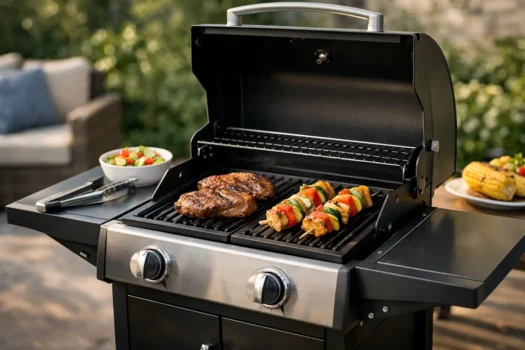
A two burner gas grill is often the right answer for a couple, a small family, or anyone tired of giving up patio space to a grill they only fill twice a year. It is also one of the easiest categories to buy badly. Small grills are frequently built to hit a price point, which can mean thin metal, weak burners, uneven heat, and carts that feel loose after one season.
The useful question is not whether two burners are enough. It is whether the grill gives you enough usable cooking control for the way you actually cook. For plenty of households, a well-built two-burner model is more practical than a larger grill with extra burners that rarely get used.
Table of Contents
What a Two Burner Gas Grill Does Well
Most two-burner grills offer roughly 350 to 500 square inches of total cooking area when the main grate and warming rack are counted together. That is enough space for a weeknight dinner of chicken, vegetables, and a few burgers. It can handle a dozen burgers if you manage the space carefully, although cooking a crowd is where its limits become obvious.
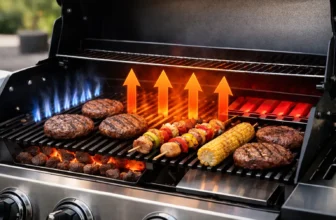
The real advantage is zoning. Two independently controlled burners let you create direct and indirect heat. Put both burners on for high-heat preheating and searing. Then turn one side down or off and move thicker food to the cooler zone to finish without burning. That is the basic technique behind better chicken pieces, pork chops, sausages, and reverse-seared steaks.
A compact grill also heats faster, uses less fuel during short cooks, and is easier to cover and clean. For a homeowner with a balcony-sized patio or a modest deck, those are ownership benefits, not minor conveniences. A grill that fits the space and gets used three nights a week is a better purchase than a four-burner unit that dominates the yard.
Where Two Burners Fall Short
Two burners do not provide much room for error when you are feeding eight or more people. You can cook in batches, but you will be managing finished food, burner settings, and flare-ups more closely than on a larger grill. There is also less dedicated indirect space for larger cuts, so a full packer brisket, multiple racks of ribs, or several beer-can chickens are not natural fits.
High-heat capacity can be limited, too. A small grill with a weak firebox may struggle to recover after cold food goes on the grate. That matters more than a large BTU number printed on the box. BTU ratings describe burner input, not how efficiently the grill holds and transfers heat. A poorly built grill can have impressive advertised output and still cook pale burgers over uneven grates.
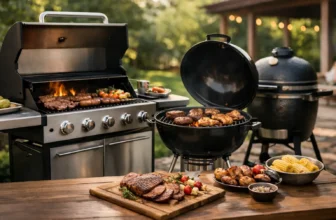
If you regularly host neighborhood cookouts, cook several large cuts at once, or want a serious smoking setup, move up to three or four burners. Do not buy a two-burner grill hoping it will behave like a full outdoor kitchen. It will not.
What to Look For Before Buying a Two Burner Gas Grill
Build quality separates a compact grill that lasts from one that becomes frustrating after a year. Start with the lid and cook box. They should feel rigid, close evenly, and avoid sharp, flimsy edges. Stainless steel can be excellent, but the word itself proves little. Thin stainless steel can discolor, warp, and rust around fasteners just as quickly as bargain painted steel.
Look under the grates as well. The burners should be solidly mounted and easy to access for replacement. Heat diffusers, sometimes called flavorizer bars or burner tents, should cover the burners well enough to reduce direct grease drips while still allowing heat to circulate. Cheap, narrow diffusers are a common reason for hot spots and recurring flare-ups.
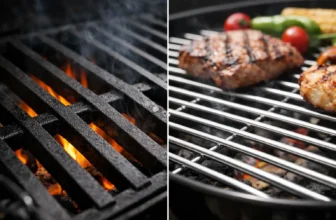
Cast-iron grates hold heat well and deliver strong sear marks, but they need cleaning and occasional oiling to prevent rust. Porcelain-coated cast iron is easier to live with, provided the coating does not chip. Stainless-steel rod grates are usually lower maintenance, though lighter versions do not retain heat as well. None is automatically best. Choose based on how much maintenance you will actually do.
Cart construction matters more than it seems. Roll the grill if possible. Check whether the wheels bind, whether the frame flexes, and whether the side shelves feel stable when you rest a platter on them. A compact grill is often moved around a patio, so a wobbly cart becomes an everyday annoyance.
Ignore BTU Hype and Check Heat Control
A good two-burner grill should preheat to a useful searing temperature in a reasonable time and, just as important, hold a lower cooking temperature without constantly going out or racing upward. Independent burner knobs with clear adjustment range are better than knobs that feel like off, medium, and full blast.
In real cooking, evenness matters more than chasing one extreme thermometer reading. Every gas grill has warmer and cooler areas. The goal is a predictable pattern you can work with. If one half of the grate runs dramatically hotter than the other, you will spend every cook rotating food instead of grilling.
A built-in lid thermometer is fine for a rough check, but it measures air near the lid, not grate temperature. Plan on using a separate digital thermometer for food, and use your experience to learn how the grill behaves. That produces better results than trusting a decorative dial.
Cleaning Is Part of the Purchase Decision
Gas grills are convenient only when grease management is sensible. On a two-burner model, look for a removable grease tray and catch pan that can be reached without dismantling half the grill. A hidden, awkward grease system is the kind of design flaw that encourages skipped cleanings, flare-ups, pests, and eventually grease fires.
After each cook, run the grill hot with the lid closed for several minutes, then brush the grates once they are safe to handle. Empty the grease pan regularly, especially after fatty burgers, skin-on chicken, or marinated meats. A deeper cleaning a few times per season should include lifting the grates and diffusers, brushing debris from the cook box, and checking burner ports for blockages.
Do not pressure-wash burners or soak the ignition system. Keep the grill covered when it is cool and dry, but do not treat a cover as a substitute for cleaning. Trapped moisture can accelerate corrosion, particularly in humid or coastal areas.
Choose Features That Solve Real Problems
Side shelves are useful if they are sturdy enough for a tray of raw food and a cutting board. Folding shelves are valuable where space is tight, but inspect the hinges and supports. A cabinet is helpful for hiding the propane tank and basic tools, while an open cart makes tank changes simpler and can dry faster after rain.
A side burner sounds useful, but on many compact grills it is underpowered and lightly built. It is worth paying for only if you genuinely cook sauces or side dishes outdoors. The same applies to sear zones, rotisserie attachments, and app-connected thermometers. These can be useful additions, but they should not distract from the basics: a solid firebox, reliable ignition, good grates, controllable burners, and easy cleanup.
Before buying, check five practical details:
- Can you reach the grease tray without tools?
- Are replacement burners, grates, and igniters available?
- Does the lid clear your railing, wall, or overhead structure when open?
- Can the grill create a usable indirect zone with one burner off?
- Is the warranty clear about burners, grates, firebox, and labor?
Replacement-part availability deserves special attention. Igniters, burners, grates, and heat diffusers are wear items. A grill with readily available parts can remain useful for many years. A grill with no parts support may become landfill-bound after one failed burner or broken igniter.
Set Up Your Two Burner Gas Grill for Better Results
Start every cook with a full preheat, usually 10 to 15 minutes with both burners on high and the lid closed. Clean the grates, then adjust the burner settings for the food. For burgers and thin steaks, use direct heat. For bone-in chicken, thicker chops, or sausages, brown over direct heat and finish on the cooler side.
Keep one side clear whenever possible. On a two-burner grill, that open zone is your safety valve for flare-ups and over-browning. If fat ignites, move the food rather than repeatedly blasting it with water or leaving the lid open. Closing the lid briefly and reducing heat can help calm the flare-up, but do not walk away.
Use the warming rack as a holding area, not a primary cooking surface. It is useful for buns, rested food, or vegetables that are already nearly done. It will not replace the indirect capacity of a larger grill.
The best two-burner gas grill is not the smallest, cheapest model or the one with the flashiest badge. It is the one that fits your space, gives you a reliable hot side and cool side, and remains easy enough to clean that you will keep using it. Buy for your normal Tuesday dinner first. The occasional big party can be managed in batches.
Quick Buying Verdict
| Your Situation | Is a Two-Burner Grill Enough? | Recommendation |
|---|---|---|
| Cooking for 1–2 people | Yes | A quality two-burner is more than sufficient |
| Cooking for 3–4 people | Yes | Probably the sweet spot |
| Cooking for 5–6 people regularly | Usually | Consider a larger three-burner if budget and space allow |
| Regularly feeding 8+ people | Not ideal | Choose three or four burners |
| Small balcony or patio | Yes | Prioritize compact dimensions and folding shelves |
| Burgers, chicken, vegetables, steaks | Yes | Two-zone cooking covers most needs |
| Frequent brisket/rib cooks | Limited | More indirect cooking space is useful |
| Serious outdoor smoking | No | Consider a dedicated smoker or larger cooker |
| Occasional large parties | Yes, with batches | Keep the two-burner and cook strategically |
| Want minimum cleanup | Yes | A smaller grill is easier to maintain |
| Want lots of cooking zones | Limited | Three or four burners offer more flexibility |
A two-burner gas grill is enough for most everyday cooking when you normally feed two to four people. The important thing is not the number of burners but whether the grill provides reliable heat, independent burner control, a usable indirect zone, quality grates, and sensible grease management. If you regularly cook for large groups or large cuts of meat, the extra space of a three- or four-burner model becomes worth paying for.
FAQ: Is a Two Burner Gas Grill Enough for You?
Is a 2-burner gas grill big enough for a family?
Yes, for most small families. A quality two-burner grill typically provides enough usable cooking space for burgers, chicken, vegetables, steaks, and other everyday meals for two to four people.
The limitation appears when you regularly cook for six or more people. You can still cook in batches, but a three-burner grill gives you more room and makes temperature zoning easier.
What can you cook on a two-burner gas grill?
A two-burner gas grill can handle most everyday grilling, including burgers, steaks, chicken, pork chops, sausages, fish, vegetables, and kebabs.
Its two independently controlled burners also allow basic two-zone cooking. You can sear food over direct heat and then move it to the cooler side to finish. This makes a good two-burner grill considerably more versatile than its compact size suggests.
Is a 2-burner or 3-burner gas grill better?
Neither is universally better. A two-burner grill is usually the better choice for couples, small families, limited patios, and straightforward weeknight cooking. A three-burner grill makes more sense if you regularly feed larger groups or want more flexibility for indirect cooking.
If you are unsure, ask yourself how often you actually need the extra space. Buying a larger grill “just in case” can mean paying more for fuel, footprint, and maintenance that you rarely use.
Can you grill steaks on a two-burner gas grill?
Yes. A good two-burner grill can produce excellent steaks if it reaches and maintains sufficiently high heat.
Preheat both burners with the lid closed, then use the direct-heat side for searing. You can turn one burner down or off and move the steak to the cooler side if you need to finish it more gently. A reliable instant-read thermometer is more useful than relying solely on the grill’s lid thermometer.
Is a two-burner gas grill good for indirect cooking?
Yes. In fact, two-zone cooking is one of the main advantages of having two independently controlled burners.
Run one burner and leave the other off to create a cooler indirect zone. This works well for chicken pieces, sausages, thicker pork chops, and reverse-searing steaks. However, the indirect zone is relatively small, so a two-burner grill is not the best choice for very large cuts, multiple racks of ribs, or serious smoking.
Final Verdict
Buy a two-burner gas grill if your normal meal is dinner for two to four people and you value compact size, quick preheating, easier cleaning, and straightforward temperature control.
Move to three or four burners if large gatherings, multiple cooking zones, or large cuts of meat are part of your normal routine—not merely the occasional barbecue fantasy.