 globalgrillguidecom
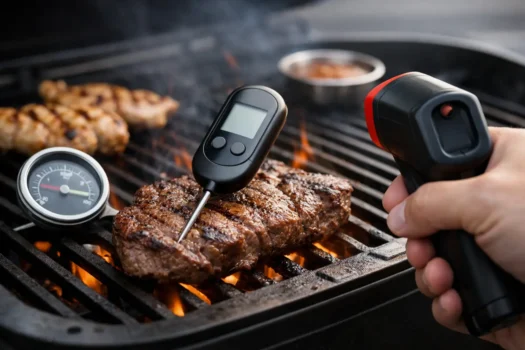
A thermometer that reads 25 degrees off can ruin a brisket faster than a bad rub ever will. When people search for best grill thermometer accuracy, they usually want a simple winner. The problem is accuracy is only part of the story. A thermometer can be technically accurate in a lab and still mislead you at the grill if it responds slowly, drifts over time, or reads the wrong spot.
That is why the right question is not just which thermometer is most accurate. It is which type of thermometer stays accurate in real backyard cooking, with heat, grease, weather, and repeated use working against it.
What best grill thermometer accuracy actually means
Most buyers see an accuracy claim like plus or minus 1 degree or plus or minus 2 degrees and assume that tells the whole story. It does not. Accuracy is the difference between the displayed temperature and the true temperature, but manufacturers do not always make that claim under the same conditions. Some quote accuracy only in a narrow range. Others sound precise on the box but offer little detail about how the unit performs across low-and-slow smoking temps and high-heat searing temps.
For grill use, accuracy has three practical parts. First, the sensor needs to be correct. Second, it needs to get to the correct reading quickly enough to be useful. Third, it needs to keep doing both after months of use. If any one of those breaks down, the thermometer becomes less helpful than the spec sheet suggests.
This is where a lot of cheap thermometers fall apart. They may be close enough at room temperature or in one test point, but drift under repeated heat cycles or take so long to settle that you pull meat early or late while waiting on the display.
The two kinds of accuracy that matter at the grill
Food temperature accuracy
If you are checking steak, chicken, pork loin, or burgers, food temperature accuracy matters most. This is the reading that determines whether meat is safely cooked, still juicy, or already on its way to drying out. For instant-read thermometers, a difference of 2 to 3 degrees is usually acceptable for home grilling. Under that is better, especially for lean cuts and fast cooks.
Response time matters here almost as much as raw accuracy. If you have to hold a probe in a thin pork chop for six seconds while the reading creeps upward, you can overshoot the target just by leaving the lid open and losing control of the cook. A fast thermometer with consistent readings is more useful than a slower one with a slightly better claim on paper.
Ambient grill temperature accuracy
Probe thermometers that track grate or chamber temperature serve a different job. They help you manage a smoker, pellet grill, or kettle during longer cooks. Here, accuracy still matters, but placement matters just as much. A perfectly good probe clipped near a hot metal wall or directly over a heat source can show a false picture of the cooking environment.
That is why grill lid thermometers are often the weak link. Even when they are not defective, they measure at the lid instead of where the food sits. The difference can be large enough to change cook times and bark development. If you care about consistency, a grate-level probe is almost always the better reference point.
Why probe placement can make a good thermometer look bad
A lot of complaints about thermometer accuracy are really placement problems. Put a probe too close to bone, fat pockets, or the cooking grate and the reading can skew. The same thing happens with ambient probes when they sit directly in radiant heat or too close to the edge of the grill.
For meat, the sensor tip should sit in the thermal center of the food, away from bone and not poking through to the other side. For ambient readings, the probe should sit near the food, at grate level, in the area that represents the actual cooking zone. That sounds basic, but it is the difference between useful data and noise.
If one thermometer says 250 and another says 275, do not assume one is defective right away. Check where each probe sits. On many grills, especially charcoal and offset setups, both readings may be accurate for those exact locations.
Best grill thermometer accuracy by thermometer type
Instant-read thermometers
For most backyard cooks, this is where the best grill thermometer accuracy starts. A good instant-read thermometer gives fast, repeatable readings and helps prevent overcooking on steaks, chicken pieces, chops, and burgers. These are the most practical tools for direct grilling because they tell you what the food is doing right now.
The trade-off is obvious. They do not monitor continuously. You still need to open the grill and check manually.
Leave-in probe thermometers
These are the better fit for smoking, roasting, and any cook where tracking progress matters more than spot checks. The best ones give dependable meat and ambient readings over hours, not minutes. Their accuracy depends not just on the sensors but on cable durability, connector quality, and resistance to moisture and grease.
The trade-off is that probe systems tend to have more failure points. Cables wear out. Water intrusion happens. A cheap probe set can look fine for a few cooks and then start giving erratic numbers.
Wireless smart thermometers
Wireless units are convenient, especially for longer cooks, but accuracy is more variable. Some perform very well. Others trade a bit of precision and consistency for app features and cleaner presentation. Convenience is real, but it should not outrank reliable readings.
This is one category where marketing often gets ahead of performance. If accuracy is your top priority, evaluate the sensor reputation first and the app second.
How to judge accuracy before you buy
Ignore polished product pages and focus on a few practical signals. Look for a clearly stated accuracy range, not vague language like precision sensor. Check whether the company explains performance across the temperature range you actually use. A smoker running 225 is different from a grill surface during a sear.
Pay attention to response time. For instant-read models, speed affects real-world usefulness almost as much as accuracy. A thermometer that reaches a stable reading in two to three seconds is much easier to trust during active cooking than one that takes five or six.
Calibration matters too. Some thermometers are user-calibratable, which adds value if you plan to keep the tool for years. Others are factory set with no adjustment option. That is not always bad, but if drift develops, you have fewer ways to correct it.
Build quality is another clue. Weak battery doors, soft buttons, loose probe hinges, and flimsy cables often show up in the same products that struggle with consistency over time. Accuracy is not only a sensor issue. It is also a durability issue.
Simple ways to check your thermometer at home
If you want to know whether your thermometer is trustworthy, test it. An ice bath is the most accessible check. In a proper ice-water slurry, a thermometer should read close to 32 degrees Fahrenheit. Boiling water can also help, though your local elevation affects the expected reading.
These tests do not prove perfect performance across every grill temperature, but they can reveal major problems or drift. If your thermometer misses badly in an ice bath, there is no reason to trust it with expensive meat.
Repeatability is just as important. If you test the same setup several times and get different readings, that inconsistency is a red flag even if one result looks correct.
When accuracy matters most and when it matters less
Not every cook needs laboratory-level precision. If you are grilling hot dogs or finishing heavily marbled thighs, a degree here or there is not a crisis. But on chicken breast, pork tenderloin, reverse-seared steak, and long barbecue cooks, tighter control pays off.
The key is matching the tool to the job. For weeknight grilling, a fast and dependable instant-read thermometer usually delivers the best value. For overnight smoking or all-day ribs, a reliable leave-in probe setup matters more. Chasing the absolute smallest tolerance number is not always the smartest buy if the thermometer is slow, fragile, or awkward to use.
At Global Grill Guide, that is the line we care about most – not what looks best in product photos, but what holds up when the grill is hot and dinner is on the line.
A good grill thermometer should help you cook with less guesswork, not give you one more thing to second-guess. Buy for consistent accuracy, fast readings, and durability, and you will make better food long after the packaging claims stop mattering.