 globalgrillguidecom
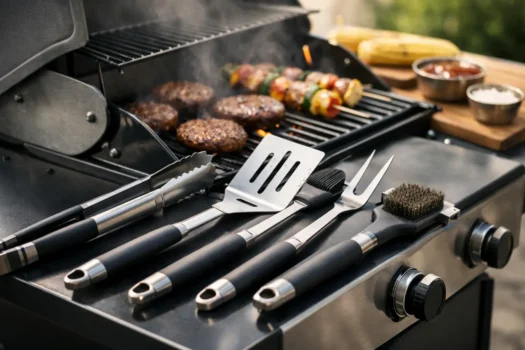
A best grill tool set is not the one with the most pieces in a polished aluminum case. It is the one that lets you turn, move, baste, and clean food over high heat without flexing in your hand, dropping a burger through the grates, or adding a drawer full of gimmicks you never use.
That sounds obvious, but grill tool sets are often sold as gifts, and gift-oriented sets are built around appearance. You get 20 or 30 pieces, a thin spatula, lightweight tongs, a small brush, corn holders, skewers, and tools whose purpose is hard to identify. The case looks impressive on day one. By the end of a season, the useful tools are bent, the brush is shedding bristles, and the rest of the kit is taking up space.
For most home cooks, the right set is simpler: a strong spatula, dependable tongs, a grill brush or scraper that suits your grates, and maybe a basting brush or fork. Quality matters more than quantity because these tools live close to direct heat, grease, ash, and frequent washing.
Table of Contents
What Makes the Best Grill Tool Set?
Start with the metal. Stainless steel is the practical choice for most buyers because it resists rust, cleans up easily, and holds up better than painted or chrome-plated steel. A tool does not need to be excessively thick, but it should not twist easily when you press a burger, lift chicken quarters, or scrape a grate. Thin metal is especially frustrating in a spatula, where flex turns a simple flip into a balancing act.
Handle design matters just as much. Long handles keep your hands farther from flare-ups, but extreme length can make smaller grills feel awkward. For a standard gas grill, kettle grill, or pellet grill, roughly 16 to 18 inches is usually a useful range. Look for a handle that feels secure with a greasy glove or damp hand. Smooth metal handles are durable and easy to wash, while heat-resistant silicone grips can be more comfortable. Wood handles look good, but they need more care and do not belong in a dishwasher.
The connection between handle and tool head is a common failure point. Riveted or welded construction is preferable to parts that feel loosely assembled. Give a spatula or tong a firm squeeze before buying if you can. Any rattle, obvious side-to-side movement, or sharp unfinished edge is a reason to move on.
A storage case is not a quality signal. It can be useful if you transport tools to campsites or tailgates, but it adds little value for a backyard grill that already has hooks or a drawer. Spend the money on stronger core tools instead.
The Four Tools Most Grillers Actually Need
A complete grill setup does not require a giant kit. These are the pieces that earn their space.
A wide, stiff spatula
For burgers, fish, chicken thighs, and many vegetables, the spatula is the most important tool in the set. A good one has a broad head with a thin enough leading edge to get under food, plus enough stiffness to lift a loaded burger without folding. An offset handle is helpful because it keeps your knuckles farther from the grate.
Avoid spatulas with overly aggressive serrated edges, bottle openers, measuring marks, and oversized cutouts if they compromise strength. Small drain slots are fine. The basic job is to slide under food cleanly and hold it securely.
Locking tongs with real tension
Tongs handle sausages, wings, vegetables, ribs, and anything you need to reposition without piercing. They should open smoothly, close with controlled tension, and lock shut for storage. Scalloped stainless tips are versatile and hold food better than flat, slippery ends.
Do not buy flimsy tongs just because they are included. Weak tongs become unreliable around heavier food, and poorly designed locks tend to fail after repeated use. If you cook on cast iron grates, choose tongs with enough length that your hands are not hovering over the heat zone.
A grill-cleaning tool matched to your grate
Cleaning is where many sets get careless. Wire bristle brushes can clean effectively, but loose bristles are a real concern if the brush is worn, poorly made, or used aggressively. Inspect one before every use and replace it at the first sign of deterioration. Never assume a brush is safe forever because it is stainless steel.
Many owners are better served by a bristle-free scraper, coil-style cleaner, or grill stone, depending on the grate material and how they maintain their grill. Porcelain-coated grates need a gentler approach than heavy cast iron. The best cleaning tool is the one you will use consistently without damaging the cooking surface.
A basting brush, if you use sauces
A basting brush is useful for barbecue sauce, butter, oil, and glazes, particularly when cooking chicken, ribs, or vegetables. Silicone brushes are easier to clean and do not shed fibers like natural-bristle brushes. Their drawback is that they can hold less sauce, so a traditional brush may still appeal to cooks who apply heavier layers.
If you rarely baste food, skip this piece. A small heat-safe bowl and spoon can do the same job with less clutter.
Tools That Are Useful, but Not Essential
A grill fork can help move large roasts or whole chickens, but it is not needed for everyday grilling. Piercing steaks, burgers, and sausages lets juices escape, so tongs and a spatula should do most of the work. If a set includes a fork, treat it as a secondary tool, not a selling point.
Skewers are worth having if kebabs are part of your regular rotation. Flat stainless skewers prevent food from spinning when you turn them. Round skewers are less expensive and work fine, but they require more patience. This is one area where buying a separate set makes more sense than accepting low-quality skewers bundled into a large kit.
Meat claws, burger presses, corn holders, grill mats, and injector needles can be useful for specific cooking styles. They are not proof that a set is better. Buy specialty tools after you identify a repeated need. Most people do not need them on their first day with a grill.
Match the Set to How You Cook
A small gas grill owner cooking weeknight burgers and chicken needs a different setup than someone running a large charcoal cooker every weekend. On a compact grill, shorter tools are easier to control and store. For charcoal cooking, longer tongs and a sturdy spatula provide more distance from radiant heat. Pellet grill owners may prioritize a scraper and basting tools because indirect cooking and sauced foods are common.
If you cook delicate fish, look for a thin fish spatula separately. Most bundled spatulas are too thick for the job. If you regularly cook ribs or brisket, a pair of heat-resistant gloves may be more valuable than half the accessories in a conventional grill set. And if you use a griddle insert, a flat-edged scraper and wide turner are better purchases than standard barbecue tools.
The key is to avoid buying for an imagined version of your backyard cooking. Buy for what you make now, then add tools when your habits change.
How to Spot a Set That Will Not Last
Read past the piece count and look for warning signs: vague metal descriptions, no mention of stainless steel, short handles, thin stamped tool heads, and an unusually large number of novelty accessories. A low price can be reasonable for a simple starter kit, but it usually means compromises in thickness, fit, and finish.
Also consider cleanup. Dishwasher-safe tools are convenient, but they still last longer when dried after washing rather than left wet in a closed grill cabinet. Grease and moisture collect in joints, around hanging loops, and under soft grips. A set that is easy to inspect and clean is more likely to stay usable.
For long-term ownership, it is often smarter to buy a modest three- or four-piece stainless set from a reputable maker, then replace or add individual tools as needed. That approach costs less than repeatedly replacing a large bargain kit.
A good grill tool set should disappear into the routine: it feels balanced, cleans up without drama, and works the same on the hundredth cook as it did on the first. That is the standard worth paying for.
Comparison Table: Best Grill Tool Set: What Actually Holds Up
| Tool / Feature | What to Look For | Why It Matters | Priority |
|---|---|---|---|
| Spatula | Wide, stiff stainless-steel head with a thin leading edge | Slides under burgers, fish, chicken, and vegetables without bending | Essential |
| Tongs | Locking stainless-steel tongs with good tension and scalloped tips | Provides secure control without piercing food | Essential |
| Grill Cleaning Tool | Bristle-free scraper, coil cleaner, grill stone, or suitable brush | Removes residue without unnecessarily damaging the grates | Essential |
| Basting Brush | Heat-safe silicone or quality natural-bristle brush | Useful for sauces, oils, butter, and glazes | Optional |
| Grill Fork | Sturdy stainless steel with a comfortable handle | Useful for large cuts but can pierce and release juices from smaller foods | Secondary |
| Skewers | Flat stainless-steel skewers for kebabs | Prevent food from spinning when turned | Optional |
| Specialty Tools | Burger press, meat claws, injector, corn holders, etc. | Useful only for specific cooking habits | Usually unnecessary |
| Material | Quality stainless steel | Resists rust, handles heat, and is easy to clean | Essential |
| Handle Length | Roughly 16–18 inches for general backyard grilling | Keeps hands away from heat without becoming awkward | Important |
| Handle Grip | Secure metal or heat-resistant silicone | Improves control with wet or greasy hands | Important |
| Tool-to-Handle Connection | Riveted or welded construction | Prevents looseness and premature failure | Essential |
| Storage Case | Durable case only if you actually transport tools | Convenient for camping or tailgating but unnecessary for many backyard setups | Optional |
| Dishwasher Compatibility | Dishwasher-safe construction where possible | Makes regular cleaning easier | Useful |
| Piece Count | Small, useful core set rather than 20–30 pieces | Reduces clutter and avoids paying for gimmicks | More quality, fewer pieces |
What Makes a Grill Tool Set Worth Buying?
| Buying Factor | Good Sign | Red Flag |
|---|---|---|
| Metal Quality | Clearly specified stainless steel | Vague “premium metal” claims |
| Strength | Tool head stays rigid under pressure | Spatula or tongs flex easily |
| Construction | Riveted or welded joints | Loose, rattling connections |
| Handles | Secure, comfortable, heat-resistant | Slippery or excessively short |
| Piece Count | 3–4 genuinely useful tools | 20+ pieces with many novelty items |
| Cleaning | Easy to wash and inspect | Grease-trapping joints and difficult surfaces |
| Storage | Simple hooks or compact storage | Expensive case used mainly as a marketing feature |
| Long-Term Value | Individual replacement tools available | Entire set must be replaced when one tool fails |
FAQ: Best Grill Tool Set: What Actually Holds Up
What tools should a good grill tool set include?
For most backyard cooks, the essentials are a sturdy spatula, reliable locking tongs, and a grill-cleaning tool suited to your grate material. A basting brush is useful if you regularly cook with sauces, marinades, butter, or glazes. You do not need a 20-piece set to handle everyday grilling.
Is stainless steel the best material for grill tools?
For most buyers, stainless steel is the best all-around choice. It resists rust, tolerates high temperatures, is easy to clean, and generally holds up better than painted or chrome-plated steel. The important point is not simply that a tool says “stainless steel”—the construction should also feel rigid and securely assembled.
How many pieces should a grill tool set have?
For most home grillers, three or four quality tools are enough: a spatula, tongs, grill-cleaning tool, and optionally a basting brush. A larger set only makes sense if you regularly use the additional tools. A high piece count is not a reliable indicator of quality.
Are grill forks necessary?
Usually, no. Tongs and spatulas are better for most foods because they move meat without piercing it. Forks can allow juices to escape from burgers, steaks, sausages, and other foods when repeatedly pierced. A grill fork can still be useful for handling large roasts or whole poultry, but it should not be a deciding factor when choosing a tool set.
Are bristle-free grill brushes better than wire brushes?
Bristle-free cleaning tools can be a good choice because loose wire bristles are a potential safety concern, particularly when a brush is worn or damaged. However, the best cleaner depends on the grate material and how heavily you use the grill. Whatever type you choose, inspect it regularly and replace it when it becomes damaged or ineffective.