 globalgrillguidecom
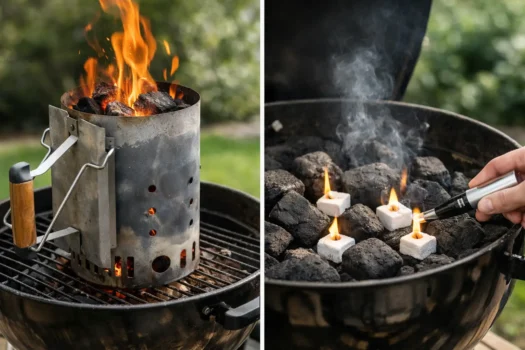
If you have ever stood over a charcoal grill with a half-lit pile of briquettes and dinner running late, the chimney starter vs lighter cubes question stops being theoretical pretty fast. Both methods work. The difference is how much control, speed, cleanup, and repeatability you get once you use them week after week.
For most home grillers, this is not really about whether charcoal can light. It is about which method gives you a more predictable start with less frustration. That matters more than marketing claims, especially if you cook often, use different charcoal types, or care about how quickly your grill settles into a usable temperature.
Table of Contents
Chimney starter vs lighter cubes: the real difference
A chimney starter is a metal cylinder with a grate inside. You put newspaper, a fire starter, or another ignition source underneath, fill the top with charcoal, and let the draft pull heat upward until the coals ash over. Lighter cubes are small solid fire starters that you place under or among charcoal to ignite it directly.
The short version is simple. A chimney starter is a tool for lighting a full batch of charcoal evenly. Lighter cubes are an ignition source. You can use cubes by themselves, or you can use them under a chimney. That overlap is where some confusion starts.
If you are comparing the two as standalone methods, the chimney usually wins on consistency for full-grill cooking. Lighter cubes win on simplicity, storage, and smaller fires. Neither is automatically better in every backyard.
Where a chimney starter pulls ahead
A good chimney starter is still the most dependable way to get a substantial charcoal fire going. Once it is lit, the airflow does most of the work. That vertical design matters because it concentrates heat and encourages the coals to catch more evenly from bottom to top.
In practical use, that means fewer weak spots in your charcoal bed. If you are grilling burgers, searing steaks, or setting up a two-zone fire in a kettle grill, an evenly lit batch is a real advantage. You dump the coals, arrange them, and cook. There is less guesswork than trying to build a charcoal pile around one or two cubes on the grate and hoping everything catches at the same pace.
A chimney is also efficient when you cook often. If you regularly light half to a full load of charcoal, the process becomes routine. Fill it, light it, wait, pour. There is very little finesse involved once you know your charcoal and your typical wait time.
The trade-off is that a chimney is one more piece of gear to own and store. It gets sooty. The handle can get hotter than you expect on cheaper models. And if you only cook small weeknight meals with a modest amount of lump charcoal, using a full-size chimney can feel like overkill.
Where lighter cubes make more sense
Lighter cubes are easier to keep around and easier to use for small jobs. You take one out of the box, place it under the charcoal, light it, and let it burn. There is no separate metal canister to clean or hang in the garage.
That makes cubes appealing for beginners, casual grillers, and anyone who values low fuss over maximum speed. They are also useful when you want to light a smaller amount of charcoal without filling a chimney halfway and trying to judge whether the burn is progressing evenly.
Cubes can be especially practical in ceramic grills, smokers, and other setups where you often light charcoal in place rather than dumping a full load of lit coals from another container. If your goal is a controlled start for a longer cook, a cube under a carefully arranged charcoal pile can be a good fit.
The limitation is scale. Lighter cubes are not always the fastest path to a fully engaged charcoal bed, especially with dense briquettes or larger volumes of lump. They can light charcoal well, but they do not create the same concentrated draft effect as a chimney. That means more variation, more waiting, and sometimes more repositioning of coals if the fire spreads unevenly.
Speed, reliability, and temperature control
If speed is the main priority, a chimney starter usually has the edge for medium to large charcoal loads. It does one job very well: getting a lot of charcoal hot and ready with consistent airflow. In real-world use, that often means a more predictable start time.
Lighter cubes can still be fast enough, but they are more dependent on charcoal arrangement, weather, and how much fuel you are trying to light at once. Wind can help or hurt. Damp charcoal slows the process. A pile that is packed too tightly may not catch well from a single ignition point.
Temperature control starts before food hits the grate. If your charcoal is unevenly lit, your grill temperature will usually reflect that. Chimneys help reduce that variability. You start with more uniformly ignited coals, which makes it easier to build a hot side and a cool side or stabilize a target cooking temp.
That said, lighter cubes are not bad for control. They are just different. For low-and-slow cooks, a slower ignition can actually be useful because you are not trying to launch a whole chimney of fully lit charcoal into the cooker. You are starting smaller and letting the fire build gradually.
Cost and long-term ownership
This is where the answer depends on how often you grill.
A chimney starter is a one-time purchase unless you buy a flimsy one and burn through it. A decent model is not expensive, and over time it can be the cheaper option if you grill regularly. You still need something to ignite it, but many people use a single lighter cube, crumpled paper, or other simple fire starters.
Lighter cubes are inexpensive per box, but they are a consumable. If you grill a lot, you will keep buying them. That does not make them a bad value. It just means the ongoing cost is part of the equation.
There is also the question of failure points. Chimneys can rust, warp, or loosen at the handle after heavy use and weather exposure. Cubes do not wear out, but they can absorb moisture if stored badly, and cheap ones may burn inconsistently. Neither method is maintenance-heavy, but neither is perfect forever.
Cleanliness, smell, and ease of use
Compared with lighter fluid, both methods are cleaner and better for flavor. That part is easy.
Between the two, lighter cubes are usually less messy to store and handle. A chimney gets coated with soot and ash quickly. That is normal, but it is not something everyone wants to carry through the garage or set on a deck box.
Smell depends on the cube material and how complete the burn is before cooking starts. Good cubes burn fairly clean, but some produce a noticeable odor while lighting. In most cases, it is not a problem if the cube has fully burned off before you cook. Still, if you are sensitive to that kind of thing, a chimney lit with plain paper or a neutral fire starter may be more appealing.
For absolute ease, cubes are simpler for a new griller. There is less handling of hot equipment and less chance of awkwardly dumping a chimney full of lit coals. But once you are comfortable with basic charcoal setup, a chimney is not difficult. It is just more physical.
Which one should you buy?
If you mostly cook burgers, chicken, steaks, and other direct-heat meals on a charcoal grill, buy a chimney starter first. It is the more dependable tool for lighting enough charcoal evenly, and it gives you a repeatable process you can trust. For most backyard grillers, that matters more than shaving off a little storage space.
If you usually light small charcoal loads, use a ceramic cooker, or want the simplest possible ignition method with minimal gear, lighter cubes make sense. They are also a solid backup even if you own a chimney.
The best setup for many people is not actually chimney starter vs lighter cubes as an either-or choice. It is a chimney starter plus lighter cubes. Use the cube to light the chimney, get the draft and even burn from the chimney, and skip the mess and smell of lighter fluid entirely. That combination is practical, low drama, and easy to repeat.
At Global Grill Guide, that is usually where we land on fire-starting gear in general: the best tool is the one that keeps your cook predictable. If your charcoal starts cleanly, heats evenly, and does not turn setup into a chore, you will use the grill more often – and that is what actually matters.
Comparison Table: Chimney Starter vs Lighter Cubes
| Feature | Chimney Starter | Lighter Cubes |
|---|---|---|
| Overall Rating | ⭐⭐⭐⭐⭐ Best for most charcoal grillers | ⭐⭐⭐⭐ Best for simplicity and small fires |
| Primary Purpose | Evenly lights an entire batch of charcoal | Ignites charcoal directly at one or more points |
| Best For | Regular grilling, medium to large charcoal loads | Small charcoal loads, smokers, ceramic grills, beginners |
| Lighting Speed | Fast and consistent for full charcoal loads | Moderate; depends on charcoal arrangement and weather |
| Evenness of Ignition | Excellent | Good, but can be uneven with larger charcoal piles |
| Temperature Control | Superior because coals ignite uniformly | Good for gradual fire building and low-and-slow cooking |
| Ease of Use | Simple after a short learning curve | Extremely easy; light the cube and wait |
| Storage | Requires additional storage space | Small, compact, and easy to store |
| Maintenance | Gets covered with soot and ash; may rust over time | Virtually maintenance-free |
| Portability | Bulky compared to cubes | Highly portable |
| Ideal Cooking Style | Burgers, steaks, chicken, two-zone grilling | Smoking, ceramic grilling, smaller weeknight cooks |
| Performance in Wind | Airflow design helps maintain ignition | More affected by wind and charcoal placement |
| Long-Term Cost | One-time purchase with minimal ongoing cost | Continuous replacement of consumable cubes |
| Potential Drawbacks | Sooty, hot to handle, requires storage | Slower for large charcoal loads and less consistent ignition |
| Flavor Impact | Clean ignition without lighter fluid flavors | Clean when fully burned before cooking |
| Best Combination | Use a lighter cube underneath the chimney for the easiest and most reliable ignition. |
Quick Buying Guide
| If You… | Best Choice |
|---|---|
| Grill every week | Chimney Starter |
| Usually cook burgers, steaks, or chicken | Chimney Starter |
| Need fast, even charcoal ignition | Chimney Starter |
| Own a kettle grill | Chimney Starter |
| Use a kamado or ceramic grill | Lighter Cubes |
| Frequently cook low-and-slow BBQ | Lighter Cubes |
| Want minimal equipment | Lighter Cubes |
| Are completely new to charcoal grilling | Lighter Cubes |
| Want the most reliable overall setup | Chimney Starter + Lighter Cubes |
FAQ: Chimney Starter vs Lighter Cubes
Is a chimney starter better than lighter cubes?
For most charcoal grillers, yes. A chimney starter lights charcoal more evenly, produces a consistent bed of hot coals, and makes it easier to create stable cooking temperatures. Lighter cubes are simpler to use but work best for smaller charcoal loads or slower ignition.
Can you use lighter cubes with a chimney starter?
Absolutely. In fact, this is one of the most effective methods. Place one lighter cube beneath the chimney, ignite it, and let the chimney’s airflow light the charcoal evenly. This combination avoids lighter fluid while providing fast and reliable ignition.
Which method lights charcoal faster?
A chimney starter is generally faster when lighting medium or large amounts of charcoal because its vertical design creates strong airflow that helps all the coals ignite evenly. Lighter cubes may take longer, especially with dense briquettes or large piles of charcoal.
Are lighter cubes safe for cooking?
Yes. High-quality lighter cubes are designed to burn completely before cooking begins and do not leave unwanted flavors on food when used correctly. Always wait until the cube has burned out and the charcoal is fully lit before placing food on the grill.
What is the best way to start a charcoal grill without lighter fluid?
The most reliable method is to use a chimney starter with one lighter cube underneath. This approach provides clean ignition, even charcoal heating, predictable cooking temperatures, and eliminates the chemical odors associated with lighter fluid.