
A rotisserie kit worth buying is not just a motor and a metal rod. It is one that fits your grill correctly, turns steadily under a real load, and gives you enough clearance to cook more than a small chicken. Get those details right, and it can produce some of the best poultry, roasts, and self-basting meat your grill can make. Get them wrong, and it becomes an awkward accessory that lives in the garage.
The basic appeal is real. As meat turns over live heat, its exterior repeatedly passes through the rendered fat and juices. That movement promotes even browning, helps protect the surface from drying out, and reduces the need to flip, reposition, or constantly baste. But a rotisserie is not a mandatory upgrade for every grill owner. Its value depends on what you cook, how often you cook it, and whether your grill can support the kit without compromise.
When a Rotisserie Kit Is Worth Buying
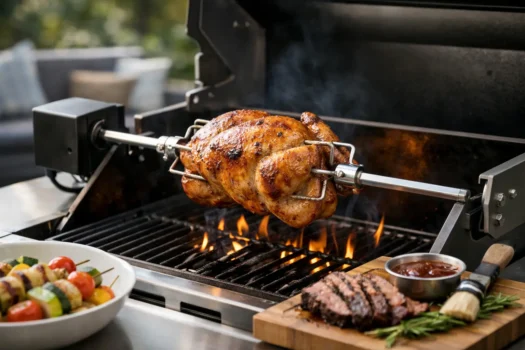
A rotisserie earns its space when you regularly cook whole birds, prime rib, pork loin, leg of lamb, or other cuts that benefit from steady, indirect heat. Whole chicken is the obvious starting point. A properly trussed chicken rotating over a drip pan cooks evenly and develops crisp, deeply browned skin without the hot-side and cool-side juggling common with indirect grilling.
It is even more useful for cooks who feed a crowd. Two chickens, a large turkey breast, or a tied roast can occupy the spit while the main grate remains free for vegetables, sausages, or a finishing sear. On many gas grills, the rotisserie burner also provides focused rear heat that is particularly effective for poultry and roasts. On charcoal grills, a spit can make heat management simpler because the food moves continuously instead of sitting in one fixed position over a fire.
The other reason to buy is consistency. Once you know where to position the coals or how high to set the burners, rotisserie cooking is repeatable. You still need a thermometer, and you still need to manage flare-ups, but the turning action removes one variable from the cook. That matters more than the novelty factor.
When You Should Skip It
A rotisserie kit is not a better way to cook every piece of meat. Burgers, steaks, ribs, kebabs, fish, and thin cuts are usually easier and better suited to standard grates. If your usual cook is a few weeknight burgers or chicken breasts, spending money on a rotisserie will not change your grilling experience much.
It also may not fit how you use your backyard. Rotisserie cooking needs a little setup time. You have to truss food, balance the load, secure the forks, set up a drip pan, and clean the rod and forks afterward. None of that is difficult, but it is more involved than putting food on the grate. If you rarely cook large cuts or prefer fast, direct-heat meals, the kit may see very little use.
Space matters too. Compact grills often lack the lid clearance for a substantial roast or a bird larger than a small chicken. A grill may technically accept a rotisserie attachment but still leave so little room that the food rubs the lid, catches the grates, or sits too close to the heat source. That is not a useful setup.
Grill Compatibility Matters More Than the Motor
The safest purchase is the manufacturer-specific kit built for your exact grill model. It should include brackets that sit securely on the firebox, a spit rod with the correct length and diameter, and a motor positioned at the right height. This costs more than a generic universal kit in many cases, but fit is the part that determines whether the accessory is easy to use or constantly frustrating.
Universal kits can work, especially on simple charcoal grills, but measure before buying. Check the distance between mounting points, the grill’s width, the height from the rod to the cooking grates, and clearance below the closed lid. Also look at where the motor will sit. A motor mounted too close to a hot firebox may have a short life, while one that wobbles on a thin bracket can make the spit bind.
Do not assume a rotisserie made for one grill brand will fit another brand’s similarly sized grill. The rod length may be close, but bracket geometry, lid shape, and cutout locations can be completely different. A loose fit is not a minor annoyance when several pounds of hot food are rotating over fire.
Check the Load Rating, but Treat It as a Limit
Motor load ratings are useful, but they are often optimistic. A kit rated for 20 pounds may turn a balanced 20-pound load under ideal conditions. It may struggle with a poorly balanced 14-pound turkey, a heavy cast-iron basket, or food that shifts during cooking.
For most home cooks, a dependable motor that handles 15 to 20 pounds is plenty. More important is smooth operation under an uneven load. Look for a motor with a solid housing, a secure on-off switch, and a mounting system that does not flex. Battery-powered motors are convenient for grills far from an outlet, but an AC motor is usually the better choice for long cooks if you have safe access to power.
The Spit Rod and Forks Are Not Minor Parts
Thin, flexible spit rods are a common weak point in budget kits. Under a heavy roast, they can sag enough to affect rotation or bring food dangerously close to the grates. A thicker stainless steel rod is easier to clean, resists rust better, and stays straighter under load.
Forks matter just as much. They need long, sharp tines that bite securely into the meat, along with screws or locking mechanisms that remain tight as the food warms. Flimsy forks allow a roast to slip on the rod. The motor may continue spinning while the meat stays in place, defeating the entire purpose of the setup.
A counterbalance is worth having for large or irregular cuts. It is not essential for a neatly trussed chicken, but it can reduce strain on the motor when cooking a turkey, a bone-in leg of lamb, or a bulky roast. If the spit lurches or stalls by hand before it goes over the heat, rebalance it before you start cooking.
What Rotisserie Cooking Does Better
The strongest case for a rotisserie is poultry. The constant movement renders fat evenly and limits the pooling that can leave one area of skin soft. With indirect heat and a drip pan below, chicken stays moist while the surface browns gradually. A rear infrared burner on a gas grill can speed up browning, though it needs close attention because rendered fat can still ignite.
Rolled roasts are another good match. Porchetta, tied pork loin, prime rib, and lamb benefit from even exposure around the entire exterior. The result is a more uniform crust than you often get from leaving a roast stationary. That said, the rotisserie does not replace good temperature control. If the grill runs too hot, the outside will overcook before the center reaches the right doneness.
It is less impressive with lean, small cuts. A boneless chicken breast can dry out quickly whether it rotates or not. Delicate foods can also tear on the forks. For those jobs, a grate, plancha, basket, or skewers are usually more practical.
The Cleanup and Ownership Reality
Rotisserie cooking is not maintenance-free. The rod, forks, brackets, and counterbalance collect grease and need cleaning after each use. Letting grease bake onto the rod makes future cooks less pleasant and can invite rust on lower-quality hardware. Hand-wash these parts with warm, soapy water after they cool, then dry them thoroughly before storage.
Use a drip pan every time. It keeps grease off the burners, flavorizer bars, charcoal grate, or firebox, and it makes cleanup far easier. A disposable foil pan is fine for convenience, but a reusable stainless pan is sturdier and creates less waste. Add a little water to the pan during long cooks if drippings are likely to burn.
Store the motor indoors or in a dry cabinet. Even motors labeled for outdoor use last longer when they are not exposed to rain, condensation, and temperature swings. Check the cord, plug, bracket screws, and fork fasteners before the first cook of the season.
What a Good Rotisserie Kit Should Include
A well-designed kit should come with a sturdy motor, a stainless steel spit rod, two secure forks, grill-specific brackets, and a counterbalance for heavier loads. A handle for removing the hot rod is helpful. A storage case is nice but not necessary.
Avoid buying based on included accessories alone. Extra forks and baskets sound useful, but a poorly fitting kit with a weak motor is still a poor purchase. Spend first on compatibility, rod strength, and motor reliability. Add a basket later only if you know you will use it for wings, vegetables, or smaller items.
The straightforward answer is that a rotisserie kit is worth buying for grill owners who cook whole birds and roasts often enough to make use of it several times each season. For everyone else, put that money toward a reliable instant-read thermometer, better charcoal, or a grill cover first. A rotisserie is a specialized tool, but when it matches the way you cook, it is one of the few grill accessories that can genuinely change the food on your plate.