 globalgrillguidecom
A wireless grill thermometer sounds like a simple upgrade until you actually rely on one during a long cook. Then the weak points show up fast. This wireless grill thermometer review is built around what matters in real use – stable connection, accurate readings, probe durability, battery life, and whether the app helps or gets in the way.
A lot of wireless models look impressive on a product page. Multiple probes, long advertised range, smart alerts, graphing, cloud features, polished photos. None of that matters much if the signal drops every time you walk inside, the probe reads hot at the tip but wrong in the center, or the battery dies halfway through a pork shoulder.
What a wireless grill thermometer review should actually cover
The biggest problem with this category is that many reviews repeat spec sheets. That tells you what the box says, not what ownership feels like. For most backyard cooks, the experience comes down to five things.
First is connection stability. A thermometer can claim 500 feet of range, but walls, appliances, patio layout, and even where the receiver sits can cut that down hard. In practice, a stable shorter-range connection is better than a longer-range one that drops out without warning.
Second is accuracy across the cooking range you actually use. Good thermometers are not just close enough at one calibration point. They need to stay dependable from lower smoking temps through hotter roasting and grilling zones. If a probe drifts, your cook times and your confidence both take a hit.
Third is probe design. Wired probes have a cable to protect, but they are often easier to replace and usually cost less. Fully wireless meat probes remove the cable mess, but they introduce charging concerns, bulkier probe bodies, and more failure points. Convenience is real. So are the trade-offs.
Fourth is app quality. Some apps are clean, fast, and useful. Others flood you with presets, pop-ups, account prompts, and laggy graphs when all you want is current temp and a reliable alert. A bad app can ruin a good thermometer.
Fifth is ownership over time. How easy is it to clean the probes? Can you buy replacements? Does the charging base feel durable or disposable? Does customer support exist beyond the return window? Those questions matter more than flashy packaging.
Wireless grill thermometer review: the real buying split
There are really two product types in this category, and they suit different buyers.
Receiver-based probe systems
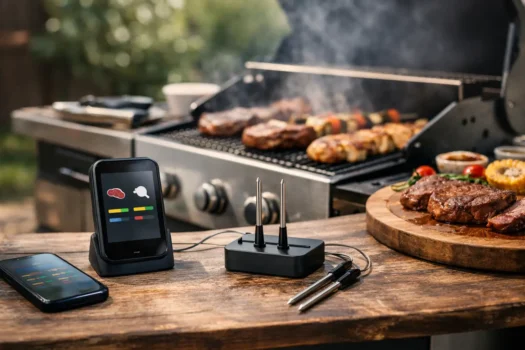
These use one or more wired probes connected to a transmitter, with data sent to a handheld receiver, phone app, or both. For many buyers, this is still the most reliable format. The probes are usually slim, replacement costs are manageable, and battery life tends to be better than fully wireless meat probes.
The downside is obvious. You still have cables running from the grill or smoker. If you cook on a kettle, kamado, or offset, cable routing takes a little attention. It is not difficult, but it is one more thing to manage.
Fully wireless meat probes
These put the sensor and transmitter into the probe itself, with data relayed to a charger, repeater, or phone. The main benefit is convenience. No wires hanging out of the lid, no pinching cables, and less clutter when cooking smaller cuts or moving food around.
The catch is performance consistency. Fully wireless probes are more sensitive to placement, signal interference, battery limitations, and high-heat exposure. Some are excellent in the right setup. Others are expensive convenience tools that work best under ideal conditions and get frustrating fast in everyday use.
What matters more than advertised range
Range is one of the most abused specs in this category. Companies love large numbers because they are easy to market. In real homes, few people need hundreds of feet of open-air range. What they need is a thermometer that holds connection from the backyard to the kitchen, upstairs bedroom, or living room.
Bluetooth-only units can work well if your cooking area is close to where you spend time. They are often simpler and less expensive. But if your patio is far from the house or your signal passes through brick, metal, or multiple walls, Bluetooth can become unreliable.
Wi-Fi-connected units usually make more sense for long cooks and larger properties. They let you monitor from farther away and avoid some of the range limitations of direct Bluetooth. Still, Wi-Fi models depend on app stability and home network quality. If your backyard Wi-Fi is weak, the thermometer may not be the real problem.
For most buyers, a dependable connection at normal home distances beats headline range claims every time.
Accuracy is not negotiable, but speed matters too
A thermometer can be technically accurate and still be annoying to use if the readings lag. Slow updates are a problem when you are grilling chicken thighs over direct heat or moving steaks between zones. During low-and-slow cooks, update speed matters less, but delayed alerts can still throw off timing.
Probe consistency also matters. If one probe reads noticeably different from another in the same environment, you stop trusting the system. That is especially frustrating on multi-probe units sold for brisket, pork butt, ambient grate temp, and carryover monitoring.
A good review should treat accuracy as a baseline and then ask whether the readings are stable, timely, and consistent enough to guide real cooking decisions.
App quality can make or break the product
This gets overlooked too often. Most wireless grill thermometers are now software products as much as hardware products. If the app is cluttered, buggy, or hard to read outdoors, the whole system suffers.
The best apps keep the basics front and center. Current temperature, target temperature, graph history, and alerts should be visible immediately. Presets are fine, especially for newer cooks, but they should not get in the way. You should not need six taps to change a target by 5 degrees.
Alert behavior matters more than many buyers expect. Notifications need to be loud enough, timely enough, and specific enough to be useful. A missed high-temp alert on a smoker can cost you a lot more than the thermometer did.
Durability and maintenance are where cheap units get exposed
A thermometer is not just an electronics purchase. It is a heat, grease, smoke, and weather purchase. Probes get handled with dirty gloves, dropped on side shelves, and cleaned in a hurry after dinner. Charging docks sit outside longer than they should. Cables get bent. Ports collect grime.
This is where cheap systems often fall apart. The readings may be acceptable at first, but long-term durability becomes the issue. Probe cables stiffen or crack. Connectors loosen. Charging contacts become inconsistent. Battery life fades quickly. None of that shows up in a first-week review.
If you grill often, replacement probe availability should be part of the buying decision. A decent base unit with affordable replacement probes is usually a better long-term buy than a slick system with proprietary parts that are hard to find or too expensive.
Who should buy a wireless grill thermometer
If you cook larger cuts, run overnight smokes, entertain while grilling, or simply want fewer lid openings, a wireless thermometer is worth having. It adds real control and convenience. For beginners, it also removes a lot of guesswork.
If you mostly grill burgers, hot dogs, and thin steaks, the value is less obvious. You may be better off with a fast instant-read thermometer plus solid grill habits. Wireless monitoring helps most when timing and internal temperature really matter over a longer window.
That is also why the best product for one person can be the wrong choice for another. A casual weekend griller may be perfectly happy with a basic two-probe Bluetooth unit. Someone running long brisket cooks from a patio far from the router may need a stronger Wi-Fi setup with better app support and more dependable alerts.
Our practical take on the category
The best wireless grill thermometer is usually not the one with the longest feature list. It is the one that stays connected, reads accurately, survives regular use, and does not make simple tasks harder.
For most buyers, receiver-based systems with wired probes still offer the best balance of reliability, cost, and long-term ownership. Fully wireless probes are appealing, and some are genuinely useful, but they make the most sense for people who value cable-free convenience enough to accept higher cost and a little more variability.
At Global Grill Guide, we put more weight on repeatability than novelty. That matters here more than almost anywhere else in outdoor cooking gear. A wireless thermometer should reduce stress, not add another thing to troubleshoot.
If you are shopping this category, ignore the hype first. Then ask a simpler question: will this unit still be dependable on your fifth long cook, not just your first? That answer will tell you far more than the box ever will.
| Feature | What to Look For | Why It Matters | Best Choice |
|---|---|---|---|
| Connection | Stable Bluetooth or Wi-Fi signal | Prevents disconnects during long cooks | Stable connection is more important than advertised range |
| Temperature Accuracy | Consistent readings across 225–500°F | Ensures reliable cooking results | ±1–2°F accuracy with fast updates |
| Probe Type | Wired vs. Fully Wireless | Affects convenience, durability, and replacement cost | Wired for reliability, wireless for convenience |
| App Experience | Simple interface with alerts and graphs | Makes monitoring easier without frustration | Clean app with customizable notifications |
| Battery Life | Long runtime and easy charging | Essential for overnight smoking sessions | Multi-cook battery life with reliable charging |
| Probe Durability | Heat-resistant, waterproof, easy to clean | Extends product lifespan | Replaceable probes with strong build quality |
| Replacement Parts | Easily available probes and accessories | Reduces long-term ownership costs | Brands with affordable replacement probes |
| Maintenance | Easy cleaning of probes and charging dock | Keeps readings accurate over time | Minimal maintenance with durable materials |
| Best For Beginners | Two-probe Bluetooth system | Affordable and simple to use | Everyday grilling and smoking |
| Best For Frequent Smokers | Wi-Fi multi-probe system | Better monitoring over long cooks | Long-distance monitoring with stable alerts |
FAQ
Are wireless grill thermometers accurate?
Yes. Quality wireless grill thermometers are typically accurate within ±1–2°F. Accuracy depends on probe quality, calibration, and proper placement inside the meat.
Is Bluetooth or Wi-Fi better for a wireless grill thermometer?
Bluetooth is ideal for smaller patios and short-range monitoring. Wi-Fi is better for long smoking sessions, larger homes, and monitoring your cook from virtually anywhere with internet access.
Are fully wireless meat probes better than wired probes?
Not necessarily. Fully wireless probes eliminate cables and are convenient, but wired probe systems generally offer better reliability, lower replacement costs, and fewer connection or battery issues.
How many probes do I need?
- 1–2 probes: Everyday grilling and small families.
- 4 probes: Smoking multiple cuts or monitoring both meat and grill temperature.
- 6+ probes: Large gatherings or competition-style cooking.
What features matter most when buying a wireless grill thermometer?
Focus on:
- Stable connection
- Accurate temperature readings
- Reliable alerts
- Long battery life
- Durable probes
- User-friendly mobile app
- Availability of replacement probes