
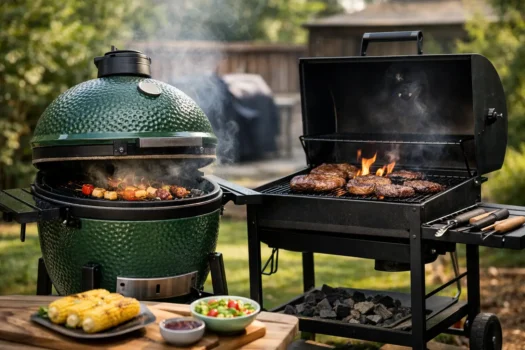
A ceramic grill vs charcoal comparison can sound backward at first. Ceramic grills burn charcoal, after all. The real choice is between a ceramic kamado-style cooker and a conventional charcoal grill, such as a kettle, barrel, or cart-style model. Both can produce excellent food. They differ sharply in cost, heat behavior, cooking capacity, cleanup, and how much work they demand on a normal weeknight.
No hype: a ceramic grill is not automatically better because it costs more and looks more substantial. It is better at a specific set of jobs. A conventional charcoal grill is often the smarter buy for people who want direct heat, larger cooking areas, easier ash removal, and less commitment.
Ceramic Grill vs Charcoal: The Core Difference
A ceramic grill uses thick ceramic walls, a tight-fitting lid, and adjustable vents to hold heat and control airflow. Most are built around a round firebox with a charcoal grate low in the body and a cooking grate above it. The design is exceptionally efficient once it is up to temperature.
A conventional charcoal grill has thinner metal walls and a less insulated cooking chamber. That means it responds faster when you adjust vents or add fuel, but it also loses more heat to the air. On a mild afternoon, that may not matter much. In cold weather, wind, or a long overnight cook, it matters a lot.
The practical takeaway is simple. Ceramic cookers favor steady, controlled cooks. Standard charcoal grills favor flexibility, speed, and space for the money.
Temperature Control and Heat Retention
Ceramic is hard to beat for stable low-and-slow cooking. Once a kamado is settled at 250°F, it can hold that range for many hours on a load of lump charcoal. Its insulated body reduces the effect of cold weather and makes small vent adjustments more meaningful. That is useful for pork shoulder, brisket, ribs, and long roasts when you do not want to add fuel every few hours.
There is a trade-off. A ceramic grill is slow to change direction. If you overshoot your target temperature, closing the vents does not cool the cooker immediately because the ceramic has already absorbed a great deal of heat. Beginners often make the mistake of opening the vents too far during startup, then spend the next hour trying to bring an overheated grill back under control.
A kettle or barrel grill is less stable but more responsive. You can raise or lower a charcoal grate, spread coals, add a water pan, or open the lid briefly to manage heat. That makes conventional charcoal grills more forgiving for direct cooking, especially burgers, chicken thighs, sausages, and vegetables. They are also easier to cool down after a cook.
For high-heat cooking, ceramic grills can reach temperatures that many basic charcoal grills cannot sustain. A well-built kamado can handle searing and pizza temperatures above 600°F. But those results depend on learning airflow and using the right accessories. A $400 ceramic cooker does not automatically make better pizza than a $200 kettle with a good charcoal setup and some practice.
Cooking Space Is Often the Deciding Factor
Do not compare grill diameter alone. Compare usable grate space and the shape of the food you cook.
Ceramic grills tend to have round grates. That works well for a whole chicken, a couple of steaks, a rack of ribs with a rib rack, or a modest-sized pork shoulder. It becomes limiting when feeding a crowd. A 18-inch ceramic grill may be advertised as capable of cooking a surprising amount of food, and technically it can with stacked racks and accessories. In real use, loading multiple levels complicates turning, checking, and removing food.
Conventional charcoal grills usually provide more accessible space for the price. A 22-inch kettle gives you a broader cooking surface than many entry-level ceramic models, while larger kettle, barrel, and offset-style charcoal grills can handle food for a party without elaborate rack systems. If you regularly cook for six or more people, cooking area deserves more weight in your decision than premium materials or peak temperature claims.
Ceramic grills are also heavy. Even smaller models can weigh well over 100 pounds, while larger units may require two people to move safely. Once installed in a nest or outdoor kitchen, they are effectively permanent. A kettle grill is not weightless, but most owners can roll it around the patio, store it under cover, or reposition it based on wind and entertaining space.
Fuel Use, Startup, and Everyday Effort
Ceramic cookers are remarkably fuel-efficient. Their insulation lets them use less charcoal during long cooks, and leftover lump charcoal can often be reused. That offsets operating cost over time, though not enough to erase the higher purchase price.
The downside is startup time. A ceramic grill needs time for the fire and the thick walls to come up to a stable cooking temperature. Plan on roughly 20 to 40 minutes for most cooks, with longer preheating for pizza or high-heat searing. Lighting it with too much fire is the fastest path to temperature overshoot.
A standard charcoal grill generally heats faster because there is less material to warm. A chimney starter full of briquettes can have a kettle ready for grilling in about 20 minutes. That does not make it convenient like gas, but it is more realistic for a weeknight dinner than a ceramic cooker that needs a careful startup and a slow cooldown.
Lump charcoal is the usual choice for ceramic grills because it burns hot and produces less ash than briquettes. Briquettes work well in many conventional charcoal grills, especially when you want predictable burn times and an easy fuel layout. Neither fuel is automatically superior. Lump varies in piece size and can burn unevenly. Briquettes produce more ash but are consistent and easy to measure.
Cleanup and Maintenance Are Not Minor Details
Ceramic grills are fairly clean during the cook because their tight design contains ash and grease well. Afterward, though, ash removal can be less convenient than it is on a kettle with a removable ash catcher. You typically rake ash through a grate or cleanout opening, and small pieces can collect around the firebox. A full burn at high heat can clean the interior, but it also uses fuel and should not replace routine ash management.
Ceramic itself does not rust, but the grill still has metal bands, hinges, grates, carts, and draft doors. Those parts need attention. The felt or gasket around the lid eventually wears out, especially after repeated high-temperature cooking. The ceramic body can also crack if it is dropped, struck hard, or exposed to a sudden temperature shock. A quality cover helps, but it does not make a ceramic grill maintenance-free.
Metal charcoal grills need their own care. Porcelain-coated kettles can last for years when covered and kept dry, while cheaper thin steel grills often rust around seams, legs, and ash pans. The good news is that conventional charcoal grills are simpler. Replacement grates, ash pans, and dampers are usually less expensive, and there is less concern about damaging a heavy ceramic shell.
Cost and Long-Term Value
Entry-level charcoal grills are usually the clear value choice. You can buy a capable kettle and the basic tools needed to use it for far less than the cost of a quality ceramic grill. That leaves budget for a chimney starter, instant-read thermometer, cover, charcoal, and better food. Those purchases improve your results more than buying an expensive grill and using it with no tools or practice.
Ceramic grills make more sense when you will actually use their strengths. If you smoke year-round, cook pizzas, roast large cuts, and appreciate long burn times, the higher cost can be justified. Build quality matters here. Cheap ceramic cookers may save money upfront but can have weak hinges, poor gaskets, unstable carts, and limited parts support. Those flaws are frustrating on any grill and especially hard to accept on a heavy, premium-priced cooker.
A conventional charcoal grill is the better long-term value for many households because it handles a wider range of casual cooking with less expense and less fuss. It is not as efficient or insulated, but it can still smoke, roast, grill, and sear extremely well when set up properly.
Who Should Buy Each Type?
Buy a ceramic grill if your priority is stable low-temperature cooking, fuel efficiency, cold-weather performance, and the ability to move from smoking to very high-heat cooking in one unit. It suits the owner who enjoys managing a live fire, has a permanent outdoor spot, and is comfortable paying more for a cooker built around heat retention.
Buy a conventional charcoal grill if you want the most cooking space and versatility per dollar, cook for groups, prefer a faster setup, or are still learning charcoal fundamentals. It is also the sensible choice if you need to move the grill often or simply do not want a 200-pound object sitting on your patio year-round.
If you are unsure, start with a quality kettle. It teaches airflow, two-zone cooking, fuel management, and temperature control without making a major financial commitment. If those skills become a hobby and you find yourself doing long cooks every weekend, a ceramic grill will have a clear purpose rather than becoming an expensive experiment.