 globalgrillguidecom
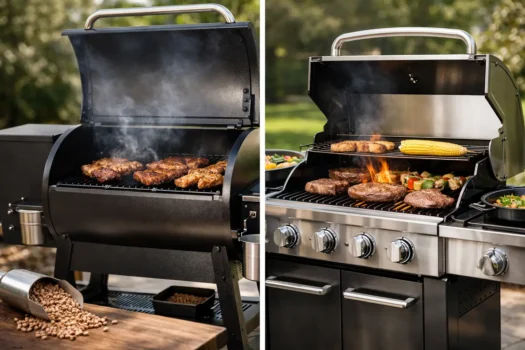
A lot of grill decisions get framed like this is a battle with one obvious winner. It isn’t. Pellet grill vs gas is really a question of how you cook, how much effort you want to spend, and what kind of ownership headaches you can tolerate.
If you want weeknight speed, a gas grill is hard to beat. If you want steadier low-and-slow cooking with more smoke flavor and less hands-on fire management, a pellet grill makes a strong case. The right pick depends less on marketing claims and more on your actual habits in the backyard.
Table of Contents
Pellet grill vs gas: the real difference
At the simplest level, gas grills burn propane or natural gas for direct heat. Pellet grills burn compressed wood pellets, using an auger and controller to feed fuel into a fire pot. That mechanical difference changes almost everything about the cooking experience.
Gas grills are built for convenience. Turn a knob, hit ignition, and you are usually cooking in 10 to 15 minutes. They handle burgers, chicken, vegetables, sausages, and fast dinners with very little setup. Heat output is immediate, and on a decent model, temperature changes happen quickly.
Pellet grills are closer to outdoor ovens with smoke capability. They take longer to start, longer to preheat, and they rely on electricity as well as fuel. In return, they offer more stable temperatures over long cooks and deliver wood-fired flavor that gas simply does not. They are especially good for ribs, pork shoulder, brisket, turkey, and anything else where time and consistency matter more than speed.
That does not mean pellet grills replace gas grills for everyone. It means they solve a different problem.
Cooking performance in the real world
For direct grilling, gas still holds the advantage for most buyers. A good gas grill gets hot fast and recovers temperature quickly after you open the lid. That matters when you are cooking for a group and managing multiple batches of food. It also matters if you like a stronger sear on steaks or chops.
Pellet grills can cook burgers and chicken just fine, but many models do not produce the same aggressive direct heat as a dedicated gas grill. Some pellet units have slide plates or sear zones, and some do it better than others, but this is one of the most common areas where expectations get ahead of reality. If your idea of grilling is mostly quick, hot, direct cooking, pellet may feel slower and less satisfying.
For smoking and roasting, pellet grills are usually the better tool. They hold set temperatures with less babysitting than charcoal and provide better smoke character than gas. The best pellet cookers also do a strong job with poultry and larger cuts because the heat is even and predictable. You are trading some top-end searing power for better low-temperature control.
This is where buyers get tripped up. They hear that pellet grills can grill, smoke, roast, and bake, which is true. But “can do everything” is not the same as “best at everything.” Gas is still the more natural fit for traditional grilling. Pellet is usually the stronger fit for mixed-use cooking that leans toward smoking.
Flavor: how much does it really matter?
This is one area where the answer depends on your expectations. Pellet grills add real wood smoke flavor, but not as much as a stick burner or charcoal setup with wood chunks. Gas grills produce very little flavor on their own beyond what comes from the food and any drippings hitting the burners or flavorizer bars.
For many home cooks, pellet smoke is enough to notice and enjoy without overwhelming the food. Chicken, pork, salmon, and ribs especially benefit from it. If you are moving from gas to pellet, the flavor difference is real. If you are expecting deep competition-style smoke intensity, that is a different conversation.
Gas can still make excellent food. A well-cooked steak on gas tastes great. So do burgers and grilled vegetables. The issue is not that gas tastes bad. It is that pellet offers a flavor layer gas does not naturally provide.
Ease of use and weeknight practicality
If convenience is the top priority, gas usually wins.
Gas grills start faster, heat faster, and shut down with less fuss. There is no hopper to fill, no auger to monitor, and no controller involved. If you grill often after work, that speed matters more than a lot of buyers admit during research.
Pellet grills are easy in a different way. Once they are running, they require less ongoing adjustment during long cooks. You set the temperature and let the controller manage the fire. That is a major advantage over charcoal for beginners. But it is not the same as fast. Startup, preheat, and shutdown cycles all take longer than gas, and that extra time adds up if you are just trying to cook a few burgers on a Tuesday.
There is also the power requirement. Pellet grills need electricity. That may not matter on a deck near an outlet, but it matters during outages, in more remote parts of a yard, or for buyers who want fewer points of failure.
Maintenance and long-term ownership
This is where the glossy marketing usually stops.
Gas grills need cleaning, but the system is mechanically simple. Burners, grates, grease management, ignition, and maybe heat tents or flavor bars – that is the core of it. Over time, burners corrode, igniters fail, and cheap parts rust out. But on a solid gas grill, maintenance is usually straightforward and parts are often easier to replace.
Pellet grills demand more attention than many first-time buyers expect. You need to manage ash in the fire pot, keep pellets dry, vacuum the interior periodically, and watch for grease buildup. The controller, auger, fan, igniter, and motor add convenience, but they also add failure points. If one component stops working, the grill may be unusable until it is repaired.
That does not make pellet grills unreliable across the board. It means build quality matters even more. A well-made pellet grill with a good controller and solid support can be a great ownership experience. A cheap one can become frustrating fast.
If your top concern is low-drama ownership over many years, a quality gas grill is often the safer bet.
Cost of entry and operating cost
Up front, gas gives you more usable grill for the money in many cases. Entry-level and midrange gas grills are widely available, and even decent models can deliver good performance for everyday grilling.
Pellet grills tend to cost more for comparable construction, partly because of the electronics and fuel delivery system. The very cheapest pellet grills often involve bigger compromises in temperature consistency, materials, or reliability than the cheapest gas grills.
Fuel cost also deserves a realistic look. Propane prices vary, and natural gas can be cheaper long term if your setup allows it. Pellets are not outrageously expensive, but frequent long cooks can add up. They also need dry storage, which is one more practical detail to manage.
For buyers watching the budget closely, gas is usually easier to justify.
Who should buy a pellet grill?
A pellet grill makes sense if you care about smoke flavor, want easier low-and-slow cooking, and are willing to accept slower startup and more involved maintenance. It is a strong fit for buyers who cook ribs, pork shoulder, chicken, turkey, and other larger cuts more often than they sear steaks.
It also works well for people who want a more forgiving path into barbecue without learning charcoal fire management. That is a real benefit. Not everyone wants to spend their weekend adjusting vents and chasing temperature swings.
Still, pellet is not ideal for every household. If your cooking is mostly quick dinners, the extra time and complexity may get old.
Who should buy a gas grill?
Gas is the better choice if you want speed, simplicity, and strong direct-heat grilling. It fits buyers who cook often, value short preheat times, and want a grill that feels easy to use without much planning.
It is also the better fit for people who mostly make burgers, steaks, kebabs, fish, vegetables, and chicken breasts. Those foods benefit more from responsiveness and high heat than from smoke exposure.
For a lot of households, gas is simply more realistic. That may sound less exciting than wood-fired cooking, but realistic is good when you are buying something you plan to use for years.
The honest answer on pellet grill vs gas
If you want one grill to handle everyday cooking with the least friction, buy gas. If you want better smoke flavor and more control for longer cooks, buy pellet. If you want both experiences at a high level, you may eventually end up with both.
At Global Grill Guide, we put more weight on ownership reality than feature lists, and this is one of those categories where the right answer depends heavily on how often the grill will actually get used. The best grill is not the one with the most claims. It is the one that matches your routine closely enough that you still enjoy using it a year from now.
Before you buy, picture a normal week, not an ideal weekend. That usually tells you whether pellet or gas belongs on your patio.
| Feature | Pellet Grill | Gas Grill | Best Choice |
|---|---|---|---|
| Best For | Smoking, roasting, low-and-slow BBQ | Fast everyday grilling | Depends on your cooking style |
| Startup Time | 15–20 minutes | 10–15 minutes | Gas |
| Temperature Control | Excellent for long cooks with digital controllers | Quick manual adjustments | Tie (different strengths) |
| Smoke Flavor | Real wood-fired flavor | Mild grilled flavor | Pellet |
| High-Heat Searing | Good on select models | Excellent on most quality grills | Gas |
| Low-and-Slow Cooking | Outstanding | Possible, but less effective | Pellet |
| Ease of Use | Set-and-forget during long cooks | Fast startup and shutdown | Gas |
| Maintenance | Ash removal, pellet management, more moving parts | Simpler cleaning and fewer components | Gas |
| Fuel | Wood pellets + electricity | Propane or natural gas | Depends on fuel availability |
| Operating Costs | Moderate (pellets) | Low to moderate (gas) | Gas |
| Best Foods | Brisket, ribs, pork shoulder, turkey, chicken | Steaks, burgers, kebabs, vegetables, quick meals | Depends on what you cook most |
| Overall Recommendation | Best for BBQ enthusiasts and smoke lovers | Best for everyday backyard grilling | Choose based on your routine |
FAQ
Is a pellet grill better than a gas grill?
Neither is universally better. Pellet grills excel at smoking, roasting, and adding wood-fired flavor, while gas grills are better for quick preheating, high-heat grilling, and convenient weeknight cooking.
Do pellet grills produce more flavor than gas grills?
Yes. Pellet grills burn real hardwood pellets that create natural smoke, giving food a richer flavor than gas grills. While the smoke is lighter than traditional stick burners, it’s noticeably more flavorful than gas alone.
Can a pellet grill replace a gas grill?
It depends on your cooking habits. Pellet grills can grill, roast, bake, and smoke, but many models don’t reach the same high searing temperatures as quality gas grills. If you mostly cook steaks and burgers, gas remains the stronger choice.
Which grill is easier to maintain: pellet or gas?
Gas grills generally require less maintenance. Pellet grills need regular ash removal, fire pot cleaning, grease management, and dry pellet storage, while gas grills have fewer moving parts and simpler routine care.
Should I buy a pellet grill or a gas grill?
Choose a pellet grill if you enjoy smoking meats, cooking low and slow, and want authentic wood-fired flavor. Choose a gas grill if you value fast startup, easy cleanup, responsive temperature control, and frequent weeknight grilling.