
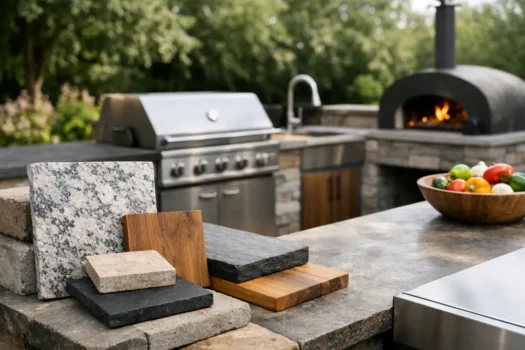
A good outdoor kitchen can outlast several grills. A bad one starts showing its age after the first hard winter, a few greasy cookouts, and one clogged drain. This outdoor kitchen materials guide focuses on what holds up under actual backyard use: heat, rain, freeze-thaw cycles, grease, dropped tools, cleaning, and the occasional neglected cover.
Looks matter, but they should not lead the decision. The material that photographs best may stain easily, crack in cold climates, trap moisture, or turn routine maintenance into a chore. Start with your climate, cooking habits, and the appliances you plan to install. Then choose finishes that can take the abuse.
Start With the Structure, Not the Countertop
The frame and base determine whether the kitchen stays square, stable, and safe. Countertops get the attention, but a beautiful surface on a weak or poorly drained structure is still a bad build.
For permanent kitchens, masonry and concrete block are proven choices. They do not rot, insects do not damage them, and they handle heat well. They are also heavy, labor-intensive, and difficult to change once built. If you expect to relocate appliances, alter the layout, or add storage later, that permanence can become a downside.
Steel framing can be a smart alternative, especially for a lighter build or a kitchen finished with panels, stone veneer, or cement board. Use framing rated for exterior conditions. Standard interior steel studs are not a shortcut worth taking. They can corrode, and they are not designed for the weight and moisture exposure of an outdoor kitchen.
Wood framing is the material we would approach most cautiously. It is familiar, relatively inexpensive, and easy to modify, but it needs serious protection from water and must be kept clear of hot appliances. Even treated lumber moves with moisture and can create trouble behind rigid finishes such as tile or stone. It can work in a covered, well-built kitchen, but it is rarely the low-maintenance option people expect.
Whatever material you choose, plan for drainage. Water should not sit against the base, collect in cabinet cavities, or run toward the house. In freeze-prone areas, proper footings and local frost-depth requirements matter more than the finish you pick.
Outdoor Kitchen Materials Guide: Cabinets and Panels
Cabinets take the daily abuse. They get splashed, heated, wiped down, kicked by chair legs, and loaded with heavy cookware. This is where cheap materials reveal themselves quickly.
Stainless steel
Stainless steel is the practical default for outdoor cabinets, doors, drawers, and appliance surrounds. It is easy to clean, does not absorb grease, and works with nearly every kitchen style. Quality varies sharply, though. Thin steel flexes, drawers bind, and low-grade hardware rusts before the cabinet box itself fails.
For exposed coastal locations, higher-grade marine stainless is worth considering because salt air is unforgiving. In most inland yards, a well-made stainless cabinet can provide many years of service if it is cleaned periodically and not left coated in grease, fertilizer residue, or standing water.
The trade-off is appearance. Stainless shows fingerprints, water spots, and scratches. It can also get hot in direct sun. Those are manageable annoyances, not structural failures, but buyers expecting a flawless showroom finish should reset expectations.
Powder-coated aluminum
Powder-coated aluminum cabinetry is lighter than steel and naturally resistant to rust. It is a strong choice for modular outdoor kitchens, especially where weight, mobility, or easier installation matters. Aluminum also handles wet climates well.
The weak point is the coating. A quality powder coat resists fading and chipping, while a cheap one can peel after repeated sun exposure or damage from impacts. Inspect corners, fastener areas, door edges, and the inside of cabinets. Those are the places corrosion and cosmetic failure often begin.
Polymer and HDPE
High-density polyethylene, often called HDPE, is common in weatherproof outdoor furniture and some outdoor cabinetry. It will not rust, does not need painting, and holds up well around moisture. It is especially useful in humid, rainy, or coastal regions.
Its limitations are heat and rigidity. HDPE can expand in hot sun, may feel less substantial than metal, and is not the right material immediately beside high-heat cooking equipment unless the manufacturer specifically allows that installation. Color can fade over time, particularly with darker shades in intense sun.
Masonry with access doors
A masonry island finished with stone, stucco, brick, or tile can be extremely durable, but it still needs quality access doors and storage components. The finish may last decades while flimsy doors, hinges, and drawer slides fail in a few years. Do not treat hardware as an afterthought. It is the part you touch every time you cook.
Choose Countertops for Heat, Stains, and Cleaning
Outdoor countertops need to survive more than a hot pan. They see grease, barbecue sauce, acidic marinades, UV exposure, rain, and winter temperature swings. The right choice depends on whether your kitchen is fully exposed, partly covered, or enclosed under a roof.
Granite remains one of the safer natural-stone choices. It handles heat well, resists scratching, and gives a permanent kitchen a finished look. But not every slab performs the same. Some granite is more porous than others and needs periodic sealing to resist oil and food stains. Choose a finish that is easy to wipe down rather than one with deep texture that captures grease.
Quartz is popular indoors but is usually a poor fit for uncovered outdoor kitchens. Many engineered quartz products can discolor, fade, or lose integrity under direct UV exposure and extreme heat. A covered patio may change the equation, but the manufacturer must explicitly approve outdoor installation. Do not assume a stone-like appearance means outdoor durability.
Concrete offers flexibility in size, shape, and color. It can create a clean, built-in look and handle heat well when properly made. The reality is that concrete can crack, stain, and require sealing. Hairline cracks may be cosmetic, but larger cracks and flaking are harder to ignore. Concrete works best for owners who accept some natural variation and will keep up with maintenance.
Porcelain slab is an increasingly practical option. It is highly resistant to stains, heat, UV exposure, and moisture, and it is easier to maintain than many natural stones. Its main drawback is installation. Large slabs require skilled handling, solid support, and careful edge treatment. A poor installation can leave corners vulnerable to chips or cracks.
Tile can be affordable and easy to replace in small areas, but grout lines are the problem. Grease, soot, and spilled sauces settle into grout, and freeze-thaw movement can loosen tiles outdoors. Tile makes more sense for a protected prep area than for an exposed, hard-working grill island.
Stone, Brick, and Stucco for Exterior Finishes
Natural stone veneer and brick give an outdoor kitchen real visual weight, and both can last a long time when installed correctly. They are good choices for permanent masonry structures in climates where the material is rated for local weather conditions. The installation details matter: flashing, drainage, proper mortar, and a stable substrate all affect longevity.
Stone veneer can be easier and less expensive than full-depth stone, but it is not maintenance-free. Mortar joints can deteriorate, and porous stone may darken or stain around the grill area. Use a suitable sealer only when the specific stone calls for it. Over-sealing can create its own problems by trapping moisture.
Stucco provides a cleaner, more modern look and can be cost-effective over masonry or appropriate cement-based construction. It is also prone to cracking if the base moves or water gets behind it. In dry climates, stucco can be a sensible choice. In wet or freeze-thaw regions, installation quality and drainage become non-negotiable.
Match Materials to Your Cooking Setup
Material choices must work with the grill, not just surround it. Built-in gas grills, pizza ovens, smokers, side burners, and charcoal grills all produce different amounts of heat and require different clearances. Follow the appliance manufacturer’s cutout, ventilation, and combustible-clearance instructions exactly. A countertop that handles heat does not make the cabinet below it safe for a grill that needs airflow.
Charcoal and wood-fire cooking deserve extra caution because embers, ash, and radiant heat are harder on adjacent surfaces than a typical gas grill. Keep combustible cabinet materials away from these appliances, choose heat-tolerant finishes nearby, and make ash removal easy. If cleaning out ash requires crawling around the island or moving furniture, it will become a neglected task.
Also plan around maintenance access. Gas shutoffs, propane tanks, electrical connections, grease trays, and water lines should be reachable without dismantling the kitchen. A permanent island should make grill service easier, not turn a simple repair into a construction project.
Where Spending More Actually Pays Off
Put the budget into the parts that are hard to replace: the foundation, frame, countertop support, weather-rated cabinet construction, doors, drawers, and hardware. These components determine whether the kitchen feels solid five years from now.
You can save on decorative finishes, lighting upgrades, and certain accessories if needed. You cannot cheaply fix a sagging countertop, water-damaged framing, or corroded drawers built into a stone island. Spend based on exposure, too. A fully covered kitchen in Arizona has different material demands than an uncovered setup near the Gulf Coast or in a northern freeze zone.
The best material is not always the toughest-looking one. It is the one that fits your weather, your appliances, and the amount of maintenance you are willing to do. Build for the cookouts you will actually host, then make sure the kitchen is still easy to clean when everyone has gone home.