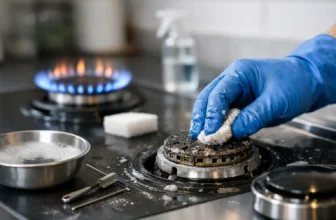

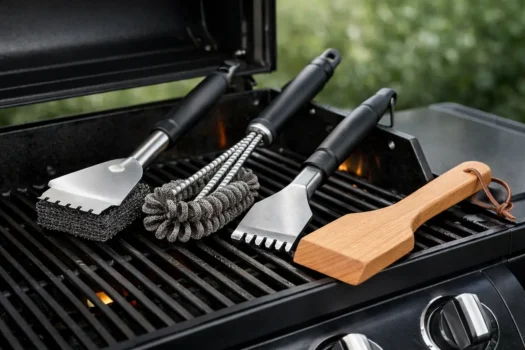
A grill brush should remove burnt-on residue without leaving behind the very thing you are trying to avoid: loose metal bristles. The best grill brushes without bristles do that job with coils, solid metal rods, scraper edges, or heat-resistant cleaning pads. None is perfect for every grate, and the right choice depends on how you cook, how often you clean, and whether your grill has traditional rod grates, porcelain-coated grates, or a flat-top surface.
Bristle-free does not mean maintenance-free. These tools still wear out, collect grease, and can damage a grate if used with poor technique. But a well-built bristle-free brush removes a common failure point from backyard grilling: thin wire bristles breaking loose and ending up where they do not belong.
What Makes a Good Bristle-Free Grill Brush
The main job is simple: remove carbonized food and grease while the grate is hot enough for residue to release. The design determines how it gets there.
Coiled stainless-steel brushes cover a broad area quickly and work well on standard round grill grates. They are usually the closest replacement for a conventional wire brush, although the coils can flatten over time. Solid-rod tools clean around individual grate bars and have no wire bundle to shed. They are exceptionally controlled but much slower on a large grill.
Steam brushes use a wet, heat-resistant pad against a hot grate. The steam softens residue, while the pad wipes it away. They are effective for routine cleanup and gentler on porcelain enamel, but they are less useful against months of baked-on neglect. Scraper-based tools are the answer for the hard stuff, especially when a grill has heavy carbon buildup.
Build quality matters more than clever packaging. Look for a handle that stays rigid under pressure, a scraper thick enough not to bend, and a head that can be replaced or cleaned when grease builds up. Avoid any product that promises to clean every grate style equally well. Grill grates vary too much for that claim to hold up.
6 Best Grill Brushes Without Bristles That Work
Grill Rescue Grill Brush Pro for routine steam cleaning
The Grill Rescue Grill Brush Pro is one of the better choices for cooks who clean after every session and want to avoid aggressive metal-on-metal scrubbing. Its replaceable aramid-fiber cleaning head is soaked in water, then used on a hot grate to create steam that loosens grease and food residue.
It works especially well on gas and pellet grills that are preheated before cooking and cleaned while still hot. The long handle gives useful reach across a wide cooking surface, and replaceable heads make more sense than replacing the entire tool when the pad gets worn or greasy.
There is a condition: the head needs to be properly wet, and the grate needs to be hot. Used dry or on a cold grill, it will not perform miracles. It is also not the fastest tool for thick carbon deposits. For regular cleanup, though, it is one of the most practical bristle-free designs available.
GrillFloss Ultimate BBQ Grill Cleaning Tool for maximum control
GrillFloss takes the opposite approach. Instead of brushing across the grate, it uses a heavy stainless-steel rod to scrape each grate bar individually. That sounds tedious because it is. On a large grill, this is slower than a wide-head brush by a wide margin.
The payoff is precision. The tool can clean the top, sides, and lower edge of round grate bars with very little chance of leaving debris behind. There are no coils to flatten, no pad to replace, and no clusters of wires to break loose. It is one of the strongest long-term choices for stainless rod grates.
This is not the pick for someone who wants a 30-second cleanup after burgers. It is a better fit for owners who care more about a thorough grate cleaning, use thick stainless cooking grates, and do not mind a more deliberate process.
Kona Safe/Clean Grill Brush for broad grate coverage
The Kona Safe/Clean Grill Brush uses coiled stainless-steel cleaning surfaces rather than conventional sharp wire bristles. Its wide head covers more grate area than a single-rod tool, making it a practical middle ground for larger gas grills and standard charcoal kettles.
The appeal is speed. With the grill hot, the coils can clear ordinary food residue with a few steady passes, and the integrated scraper helps with stubborn spots. It is also a familiar design for anyone moving away from a traditional brush but who still wants a wide scrubbing head.
The trade-off is wear. Coiled metal is safer than loose bristle bundles, but it can still bend, trap grease, and lose effectiveness if it is mashed into the grates every weekend. Inspect it regularly and replace it when the coils are flattened or damaged. Bristle-free should not be treated as indestructible.
Grillart Bristle-Free Grill Brush and Scraper for stubborn residue
The Grillart Bristle-Free Grill Brush and Scraper is a sensible choice when scraping power matters as much as brushing. Its design combines a broad metal cleaning surface with a scraper, giving it more leverage against thick residue than soft-pad options.
This is the kind of tool that earns its place when the grill has been ignored for a few cooks or when sugary sauces have baked onto the grate. It is also useful for cast-iron and stainless grates that can tolerate firmer contact.
Use more restraint on porcelain-coated grates. The goal is to remove food residue, not grind away at the coating. Let the grill preheat, make several light passes, and use the scraper only where buildup remains. A hard scraper used with too much force can be tougher on a grate than the residue it removes.
BBQ Daddy for porcelain-coated grates and gentler cleaning
BBQ Daddy uses a water-fed cleaning head with a scraper built into the tool. Like other steam-based options, it works by softening grime instead of attacking it with exposed metal. That makes it a good match for cooks concerned about preserving porcelain-coated grates or those who want an easier cleanup routine.
The head shape can reach between common grate patterns better than some flat pads, and the scraper adds useful backup for stuck-on food. It is most effective for cleanup after normal grilling, not for restoring a neglected grill that has a black, hardened layer across every bar.
The cleaning head will eventually need replacement, and that is the ownership cost to consider. If you grill frequently, factor in replacement pads rather than looking only at the initial price. For many homeowners, that ongoing cost is worth the easier, less aggressive cleaning method.
A stainless scraper for flat-top grills and griddles
A flat-top griddle does not need a grill brush. It needs a sturdy stainless scraper, ideally one with a broad blade and a comfortable handle. Trying to clean a flat surface with a coil brush is inefficient and can leave streaks of residue that a scraper would remove in one pass.
For a griddle, scrape while the surface is warm, not blazing hot. Push grease and food residue into the grease channel, then wipe the surface with a damp cloth or paper towels. If buildup is stubborn, a small amount of water can loosen it through steam. Reapply a thin coat of oil afterward if the cooking surface requires seasoning.
This is worth calling out because many accessory kits market a single tool as suitable for grills and griddles. That is usually a compromise. Use a grate-specific cleaner for grates and a scraper for a flat top.
How to Choose the Right One for Your Grill
Start with the grate material. Stainless-steel rod grates give you the most flexibility. A coil brush, rod tool, steam brush, or scraper can all work, provided you use reasonable pressure. Porcelain-coated cast iron deserves more care. A steam brush or softer bristle-free cleaning head is usually the safer choice for routine work, while metal scrapers should be reserved for isolated problem areas.
Next, be honest about your cleanup habits. If you brush the grate after every cook, a steam brush or pad-based tool will keep it in good condition with minimal effort. If cleanup tends to happen after several cooks, buy a tool with a substantial scraper. No brush design compensates for letting grease and residue harden for weeks.
Grill size also matters. A compact charcoal kettle is manageable with a precision tool like GrillFloss. A six-burner gas grill is not. On a large cooking surface, a wide coil brush or steam brush saves time and makes routine cleaning more likely.
Use a Bristle-Free Brush the Right Way
Preheat the grill for 10 to 15 minutes before cleaning. Heat turns leftover food and grease brittle or soft enough to release. With the lid open, use steady strokes in the direction of the grate bars. Do not jab straight down with all your weight. That shortens the life of the tool and can damage coated grates.
After cleaning, wipe the grate with a lightly oiled paper towel held in tongs if the grate is bare cast iron or if food sticking is a recurring issue. Then inspect the cleaning tool itself. Remove grease from steam heads, check coil tools for deformation, and make sure scraper edges have not bent or developed sharp burrs.
The best choice is the one you will actually use while the grill is still hot. A simple, well-maintained bristle-free tool used after every cook will outperform a heavy-duty brush left hanging until the grates are covered in carbon.