
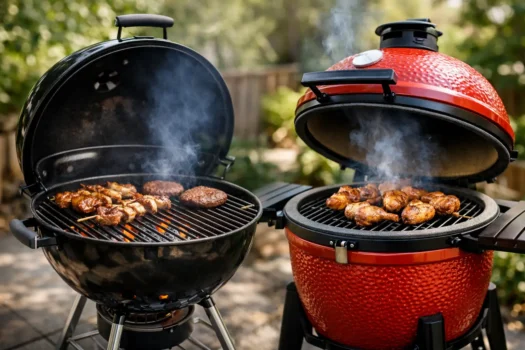
A charcoal grill vs kamado cooker decision is not really about which one makes better food. Both can turn out excellent steaks, burgers, chicken, ribs, and smoked pork. The meaningful difference is how much control you need, how much food you cook at once, and how much weight, maintenance, and upfront cost you are willing to live with for years.
A basic charcoal grill is usually the practical choice for direct grilling and flexible backyard cooking. A kamado is a high-efficiency ceramic cooker built for people who want steady low-and-slow temperatures, serious heat retention, and the ability to bake, roast, and smoke in one unit. Neither is automatically the better buy. One may be a much better fit for your patio and cooking habits.
Charcoal Grill vs Kamado Cooker: The Real Difference
A conventional charcoal grill uses a metal bowl, barrel, or firebox with adjustable vents. Heat rises from the coals, and you manage it by arranging the fuel, setting the vents, and moving food between direct and indirect zones. It loses heat faster than ceramic, but that is not always a drawback. It responds more quickly when you need to change cooking conditions, and it is generally easier to accommodate a large spread of food.
A kamado cooker is a thick-walled ceramic or insulated metal vessel with a tight-fitting lid. Once it is heated, the cooker holds temperature exceptionally well while using relatively little charcoal. Small vent adjustments can hold a smoking temperature for many hours. The trade-off is that a kamado is slower to change direction. If you overshoot your target temperature, you cannot simply open the lid and expect it to settle immediately.
Think of a charcoal grill as an adaptable open-fire tool. Think of a kamado as a heat-retaining oven that also grills. That distinction matters more than marketing claims about versatility.
Temperature Control and Cooking Range
For long cooks, the kamado has a clear advantage. Its insulation protects the fire from wind and cool weather, while its tight airflow control makes 225 to 275 degrees Fahrenheit easier to maintain once the cooker is stabilized. That makes it well suited to brisket, pork shoulder, ribs, whole chickens, and slow-roasted cuts.
A charcoal grill can smoke well too, especially with a two-zone fire, a charcoal basket, or a snake-style charcoal arrangement. But it usually needs more attention. Thin metal construction loses heat when temperatures drop, and a leaky lid or poorly fitting vents can make controlled smoking frustrating. A quality kettle grill narrows that gap considerably, but it still will not match the fuel efficiency of a good kamado.
For high-heat cooking, both designs can produce a strong sear. Kamados can reach very high temperatures, often well beyond what most backyard cooks need for steak or pizza. The ceramic walls also recover heat well after the lid is closed. But a standard charcoal grill is often faster and less fussy for a weeknight batch of burgers, sausages, or chicken thighs. Build a hot zone, cook over it, and you are done.
There is one practical warning with kamados: high heat is not the same as easy heat. Getting a ceramic cooker to pizza temperatures takes time and charcoal. Cooling it back down also takes time. If your normal meal is six burgers at 6:30 p.m., a kamado can do the job, but it is not necessarily the most convenient tool for it.
Lid Opening Changes the Equation
Every time you open any charcoal cooker, you feed the fire oxygen and lose heat from the cooking chamber. On a kamado, the effect can be more dramatic because the cooker stores so much heat in its ceramic body. Opening the lid during a low-and-slow cook may create a temperature bump that takes time to correct.
On a charcoal grill, recovery is usually faster in the sense that the cooker itself has less stored heat. You may burn more fuel, but adjusting the cooking setup feels more immediate. Cooks who like to move food around, add sauce, or manage several zones often prefer that responsiveness.
Capacity Often Decides the Purchase
Do not judge cooking space by the grill’s outside size. Many kamados have a surprisingly modest grate for their footprint. A medium kamado can handle a family dinner comfortably, but it may feel crowded when cooking burgers for 10 people, several racks of ribs, or a full spread for a holiday gathering.
A 22-inch kettle or a larger barrel-style charcoal grill usually gives you more usable room per dollar. It also gives you more freedom to create a direct zone and an indirect zone at the same time. That matters when you are grilling chicken pieces, reverse-searing steaks, or cooking vegetables away from flare-ups.
Kamado owners can add multi-level racks, deflector plates, and extender systems. Those accessories work, but they add cost and complexity. If you regularly cook for a crowd, buy enough base-level grate space from the start instead of assuming accessories will solve every capacity problem.
Fuel Use, Startup Time, and Cost
A kamado is remarkably efficient once it is running. For an overnight pork shoulder or a long brisket cook, it can use far less lump charcoal than a conventional grill or thin-walled smoker. That long-term efficiency is real, particularly for people who smoke frequently.
The upfront cost is also real. A capable kamado, stand, heat deflector, and useful accessories can cost several times more than a quality kettle grill. Replacement parts can be more expensive, and ceramic components are not immune to damage. A dropped fire ring or cracked base is a costly problem, not a cosmetic inconvenience.
Charcoal grills are less efficient, but the ownership math is simpler. They cost less to buy, replacement grates and ash parts are usually affordable, and you can spend the difference on good charcoal, a chimney starter, a reliable thermometer, and plenty of food to cook. For occasional grilling, that is often the better value.
Startup is a mixed result. A charcoal grill with a chimney starter can be ready for direct grilling in roughly 20 minutes. A kamado needs time to heat its ceramic mass, especially for roasting or pizza. It is efficient during the cook, not necessarily quick at the beginning.
Cleaning and Long-Term Ownership
Neither cooker is maintenance-free. Ash restricts airflow, grease buildup creates flare-up risk, and wet charcoal creates inconsistent fires. The difference is how each design handles the routine work.
Most conventional charcoal grills make ash removal straightforward. Many have a bottom ash catcher or sweep system, and the open shape makes it easy to brush the grate and inspect the fire bowl. Their weak point is corrosion. Cheap painted steel, thin grates, exposed hardware, and poor covers can turn a neglected charcoal grill into a rust problem quickly.
Kamados do not rust like thin steel grills, but they have their own ownership demands. Ceramic is durable under normal use, yet vulnerable to impact. Gaskets eventually wear out. Hinges and bands need periodic checks. A kamado should be protected from hard knocks, and moving one across a patio or into storage is not a one-person job in many cases.
The self-cleaning reputation of kamados needs context. High heat can burn off grease and residue, but it does not remove ash. You still need to clear the firebox and keep vents free. Do not mistake a hot burn for complete maintenance.
Who Should Buy Each Type?
Choose a conventional charcoal grill if you want straightforward direct grilling, regularly cook for groups, have a limited budget, or prefer a lighter cooker that is easier to move and replace. A quality kettle is especially hard to beat for first-time charcoal buyers. It teaches fire management without making every cook feel like a project.
Choose a kamado if low-and-slow barbecue is a major part of your cooking, you value fuel efficiency, and you want one cooker that can smoke, roast, bake, and sear. It also makes sense for cooks in colder or windier areas where insulation improves consistency. The best kamado owners tend to be patient cooks who enjoy dialing in airflow and using the same cooker for years.
Avoid a kamado if you need to move your grill often, have a small budget, or routinely feed large groups from one cooking grate. Avoid a cheap charcoal grill if you expect reliable smoking performance or plan to leave it exposed to the weather. Low price rarely compensates for poor airflow control and short service life.
Buy for Your Most Common Cook
Before spending more, picture the meal you make most often. If it is burgers, chops, vegetables, and chicken for a family of four, a solid charcoal grill will likely deliver more usable value. If it is weekend ribs, pork shoulder, pizza, and long cooks where stable temperature matters, the kamado’s extra cost can earn its place.
The right cooker is the one you will light regularly, clean without resentment, and still trust after several seasons outside. Buy for that reality, not for the most dramatic temperature claim on the box.