
A pellet grill vs offset smoker decision is not really about which cooker looks more serious on the patio. It is about how you want to spend a Saturday. One lets you load fuel, set a temperature, and focus on the food. The other asks you to manage a live wood fire for hours, then rewards that attention with a style of smoke and bark that a pellet cooker can struggle to duplicate.
Neither is automatically better. But they serve different owners, and the wrong choice can turn a long-planned barbecue purchase into an expensive piece of patio furniture.
Pellet Grill vs Offset Smoker: The Core Difference
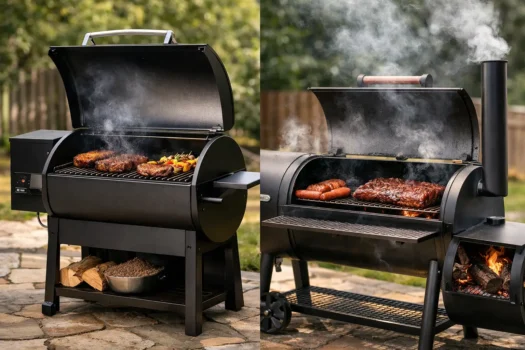
A pellet grill burns compressed hardwood pellets from a hopper. An electric auger feeds those pellets into a fire pot, while a controller adjusts the feed rate to hold your selected cooking temperature. It is a wood-fired cooker with automated fuel management.
An offset smoker burns split hardwood in a side-mounted firebox. Heat and smoke travel through the cooking chamber before exiting a chimney. The cook controls the fire with wood size, fuel timing, airflow, coal bed management, and occasional adjustments to the intake and exhaust dampers.
That difference shapes nearly everything else: flavor, workload, temperature stability, startup time, cleaning, and the skills required to get consistently good food.
Temperature Control and Ease of Use
For most backyard cooks, the pellet grill wins this category without much debate. Set it to 225°F, let it preheat, place the brisket or ribs inside, and monitor the cook with a dependable probe thermometer. Better pellet grills hold reasonably steady temperatures in normal weather, though wind and cold can still increase pellet use and cause wider swings.
This does not make a pellet grill fully hands-off. You still need to manage the food, verify internal temperatures, wrap when needed, and protect the grill from rain. But it removes the most demanding part of barbecue: maintaining a clean, stable fire for six to 14 hours.
An offset smoker requires more involvement. A well-built offset with proper airflow is easier to run than a thin, leaky budget model, but it still needs attention. Expect to add wood roughly every 30 to 60 minutes during many cooks. You need to watch the fire, not just the chamber thermometer. Thick white smoke, a smoldering firebox, or a temperature spike can affect the finished meat.
That work is not a flaw if you enjoy fire management. For some cooks, it is the point. But if you have kids’ activities, guests to host, or limited time on weekends, an offset can become more demanding than expected.
The real-world ownership test
Ask yourself whether you want to cook barbecue or tend a fire. There is no wrong answer, but be honest. A pellet grill is usually the practical choice for someone who wants repeatable results on weeknights as well as long weekend cooks. An offset fits the person who sees the fire itself as part of the hobby.
Smoke Flavor and Food Quality
An offset smoker generally produces stronger, more traditional wood-smoke flavor. Burning seasoned wood splits creates the kind of clean combustion associated with classic Central Texas brisket, deeply colored ribs, and pronounced bark. When the fire is clean, the smoke should be thin and nearly invisible, not billowing and harsh.
A pellet grill produces good barbecue, especially when cooking pork shoulder, ribs, chicken, sausage, and vegetables. It can also turn out tender brisket with solid bark. But its smoke profile is usually milder. Pellets burn efficiently in a small fire pot, and that clean, controlled burn does not generate the same level of smoke compounds as a wood-fired offset.
This gap matters more to experienced barbecue fans than casual guests. Most people will happily eat food from either cooker. But if your standard is competition-style brisket or the flavor from a respected Texas barbecue joint, an offset has the higher ceiling.
There is a trade-off: an offset also has a lower floor. Poor fire management can produce bitter smoke, dry meat, or uneven cooking. A pellet grill is less likely to create that kind of bad result, even for a beginner.
Capacity, Cooking Style, and Versatility
Offset smokers often provide a large cooking chamber, particularly traditional backyard models with a full-size barrel. They make sense for big briskets, multiple pork butts, racks of ribs, and cooks for a crowd. Larger offsets also have room to create temperature zones, although that advantage depends on the pit’s design and how the fire is managed.
Pellet grills come in many sizes, from compact models for a small family to wide units capable of feeding a neighborhood. Their advantage is versatility. Most can smoke at low temperatures, roast poultry, bake sides, and cook at moderate grilling temperatures. Some have direct-flame features, but few replace a dedicated gas or charcoal grill for hard, high-heat searing.
If burgers, steaks, and quick grilling are a major part of your routine, do not assume either option covers every need. A pellet grill can be convenient, but a simple charcoal kettle or gas grill may still be the better tool for fast weeknight searing. An offset is even less suited to quick meals because startup and fire management take time.
Cost Is More Than the Purchase Price
Entry-level pellet grills can be affordable, but build quality varies sharply. Thin metal, weak lids, basic controllers, and poorly designed grease systems tend to show their limits after a few seasons. A better-built pellet grill costs more, yet it is usually worth it if you cook often and want reliable temperature control.
Offsets have an even wider range. Cheap hardware-store offsets are often made from thin steel and leak air around doors and seams. They can cook food, but they make temperature control harder and burn through fuel faster. A heavy-gauge offset from a reputable fabricator can perform exceptionally well and last for decades, but it costs substantially more and may require freight delivery.
Fuel costs also differ. Pellets are convenient, bagged, and easy to store dry, but long cooks can use a meaningful amount. Seasoned hardwood splits may be cheaper by volume if you have a good local source, but they require storage space and must be properly dried. Green or poorly seasoned wood creates dirty smoke and frustration.
Do not overlook accessories. Pellet grills need electricity, quality pellets, a cover, and occasional replacement parts such as igniters or temperature probes. Offset owners need wood storage, fire tools, heat-resistant gloves, and ideally a good instant-read thermometer plus a multi-probe setup.
Cleaning and Maintenance Reality
Pellet grills need ash removal from the fire pot and cooker body. Neglecting this can affect ignition and, in some cases, contribute to grease-fire risk. Grease trays and drip channels also need regular cleaning. Keep pellets dry, because damp pellets can swell, jam the auger, and create a miserable cleanup job.
Offsets create more ash and soot, but their mechanical simplicity is a long-term advantage. There are no augers, control boards, fans, or igniters to fail. The ongoing work is physical: remove ash, scrape grease, manage rust, season exposed steel, and keep the cooker covered. A heavy offset can outlast most pellet grills if maintained properly.
Weather matters for both. Pellet grills depend on electrical components and perform best with protection from rain and harsh winter wind. Offsets are less electronically vulnerable, but bare steel rusts quickly when left exposed.
Who Should Buy Each Cooker?
Buy a pellet grill if you value convenience, cook frequently, want predictable results, or are new to smoking. It is also the smarter fit for homeowners with limited time, smaller patios, and neighbors who may not appreciate extended wood-fire sessions. You can make very good barbecue without turning every cook into an all-day fire-management project.
Buy an offset smoker if deep wood flavor is your priority and you genuinely want the hands-on process. It is best for cooks who have room for a large, heavy unit, access to seasoned hardwood, and the patience to learn fire control. Spend carefully here. A well-built offset is a long-term tool; a flimsy one can make barbecue feel harder than it needs to be.
There is also a middle ground. Some serious backyard cooks own a pellet grill for dependable weekday meals and an offset for weekends when they want to work the fire. That is not necessary for most households, but it reflects the real difference between these cookers rather than a marketing claim that one replaces the other.
Choose the cooker that matches the way you actually cook now, not the version of yourself you imagine after watching a few barbecue videos. The best smoker is the one you will keep clean, fuel properly, and use often enough to learn.